
Blog

  • Ezra 3

    Ezra 3

    Read Ezra 3

    Rebuilding the Altar

    When the seventh month came and the Israelites had settled in their towns, the people assembled together as one in Jerusalem. Then Joshua son of Jozadak and his fellow priests and Zerubbabel son of Shealtiel and his associates began to build the altar of the God of Israel to sacrifice burnt offerings on it, in accordance with what is written in the Law of Moses the man of God. Despite their fear of the peoples around them, they built the altar on its foundation and sacrificed burnt offerings on it to the Lord, both the morning and evening sacrifices. Then in accordance with what is written, they celebrated the Festival of Tabernacles with the required number of burnt offerings prescribed for each day. After that, they presented the regular burnt offerings, the New Moon sacrifices and the sacrifices for all the appointed sacred festivals of the Lord, as well as those brought as freewill offerings to the Lord. On the first day of the seventh month they began to offer burnt offerings to the Lord, though the foundation of the Lord’s temple had not yet been laid.

    Rebuilding the Temple

    Then they gave money to the masons and carpenters, and gave food and drink and olive oil to the people of Sidon and Tyre, so that they would bring cedar logs by sea from Lebanon to Joppa, as authorized by Cyrus king of Persia.

    In the second month of the second year after their arrival at the house of God in Jerusalem, Zerubbabel son of Shealtiel, Joshua son of Jozadak and the rest of the people (the priests and the Levites and all who had returned from the captivity to Jerusalem) began the work. They appointed Levites twenty years old and older to supervise the building of the house of the Lord. Joshua and his sons and brothers and Kadmiel and his sons (descendants of Hodaviah) and the sons of Henadad and their sons and brothers—all Levites—joined together in supervising those working on the house of God.

    10 When the builders laid the foundation of the temple of the Lord, the priests in their vestments and with trumpets, and the Levites (the sons of Asaph) with cymbals, took their places to praise the Lord, as prescribed by David king of Israel. 11 With praise and thanksgiving they sang to the Lord:

    “He is good;
        his love toward Israel endures forever.”

    And all the people gave a great shout of praise to the Lord, because the foundation of the house of the Lord was laid. 12 But many of the older priests and Levites and family heads, who had seen the former temple, wept aloud when they saw the foundation of this temple being laid, while many others shouted for joy. 13 No one could distinguish the sound of the shouts of joy from the sound of weeping, because the people made so much noise. And the sound was heard far away.

    Go Deeper

    In this chapter, we see Zerubbabel leading the rebuilding of the temple. Over 42,000 Israelites returned to Jerusalem with him, and they immediately began work on the altar and the temple foundations. However, we see in verses 12 and 13 that this work was met with very different reactions. Those who had seen the original temple, the older priests and Levites, wept at the sight of the new foundation. Those helping to rebuild shouted for joy. Verse 13 tells us that the sounds of both were so loud you couldn’t distinguish one from the other.

    Isn’t it interesting that the same event would bring such polar opposite emotions? The shouts of joy are easy to understand. This sight was a symbol of obedience, a promise of hope, and the beginning of a new future. Even though this new temple was not going to be as elaborate or ornate as the original built by Solomon, it was a reminder of God’s protection and promises. 

    But for those who had lived through the years of disobedience and punishment, who had seen the destruction of Solomon’s temple, this new building elicited weeping and conviction. The original temple was surrounded by a thriving empire, while Zerubbabel’s temple was surrounded by ruins. For those who had lived through the destruction and fall of the original temple, the sight of this rebuild was a physical reminder of God’s correction and discipline – a reminder of their failures and shortcomings. It is no wonder there was such a range of emotions. Their individual responses had a direct correlation to whether their work was destroyed by sin or whether their work was a result of obedience. 

    Paul reminds us in 1 Corinthians 3 that we are now God’s temple, and just like the Israelites, our work will be tested on judgment day. Just as the new temple was built on the original foundation built by Solomon, we are now charged with building God’s kingdom upon the foundation of Jesus. Our work will be evaluated and either rewarded or discounted. 

    When that day comes and our kingdom work is looked upon, will we weep or will we shout for joy? Will the sight of it be a reminder of our sins or will it be a symbol of our obedience and God’s faithfulness? If we are honest, there will probably be some of both. Thankfully by God’s grace, we will be saved. Let’s get to work today building something that lasts, starting with a firm foundation in Jesus and continuing with materials that pass the test – obedience, love, and faithfulness to the God who has saved us. 

    Questions

    1. Do you think you will look back at your life and weep, or will you shout for joy?
    2. If you take an honest look at your life, have you established a firm foundation in Jesus?
    3. Spend some time praying and asking God what He is wanting you to do to build His kingdom. What specific step is He asking you to take in obedience? If you feel Him prompting you, consider sharing that with someone who will help hold you accountable.

    By the Way

    Haggai addressed those who were weeping in Ezra 3 and comforted them by prophesying that the glory of this new temple would exceed the glory of the former, because Jesus was going to come and fill it with His glory! See Haggai 2:7, written around 520 B.C.

    Leave a Comment Below

    Did you learn something today? Share it with our Bible Reading Plan community by commenting below.

    Join the Team

    Interested in writing for the Bible Reading Plan? Email [email protected].
  • Ezra 2

    Ezra 2

    Read Ezra 2

    The List of the Exiles Who Returned

    Now these are the people of the province who came up from the captivity of the exiles, whom Nebuchadnezzar king of Babylon had taken captive to Babylon (they returned to Jerusalem and Judah, each to their own town, in company with Zerubbabel, Joshua, Nehemiah, Seraiah,Reelaiah, Mordecai, Bilshan, Mispar, Bigvai, Rehum and Baanah):

    The list of the men of the people of Israel:

    the descendants of Parosh2,172
    of Shephatiah372
    of Arah775
    of Pahath-Moab (through the line of Jeshua and Joab)2,812
    of Elam1,254
    of Zattu945
    of Zakkai760
    10 of Bani642
    11 of Bebai623
    12 of Azgad1,222
    13 of Adonikam666
    14 of Bigvai2,056
    15 of Adin454
    16 of Ater (through Hezekiah)98
    17 of Bezai323
    18 of Jorah112
    19 of Hashum223
    20 of Gibbar95
    21 the men of Bethlehem123
    22 of Netophah56
    23 of Anathoth128
    24 of Azmaveth42
    25 of Kiriath Jearim, Kephirah and Beeroth743
    26 of Ramah and Geba621
    27 of Mikmash122
    28 of Bethel and Ai223
    29 of Nebo52
    30 of Magbish156
    31 of the other Elam1,254
    32 of Harim320
    33 of Lod, Hadid and Ono725
    34 of Jericho345
    35 of Senaah3,630

    36 The priests:

    the descendants of Jedaiah (through the family of Jeshua)973
    37 of Immer1,052
    38 of Pashhur1,247
    39 of Harim1,017

    40 The Levites:

    the descendants of Jeshua and Kadmiel (of the line of Hodaviah)74

    41 The musicians:

    the descendants of Asaph128

    42 The gatekeepers of the temple:

    the descendants of
    Shallum, Ater, Talmon,
    Akkub, Hatita and Shobai139

    43 The temple servants:

    the descendants of
    Ziha, Hasupha, Tabbaoth,
    44 Keros, Siaha, Padon,
    45 Lebanah, Hagabah, Akkub,
    46 Hagab, Shalmai, Hanan,
    47 Giddel, Gahar, Reaiah,
    48 Rezin, Nekoda, Gazzam,
    49 Uzza, Paseah, Besai,
    50 Asnah, Meunim, Nephusim,
    51 Bakbuk, Hakupha, Harhur,
    52 Bazluth, Mehida, Harsha,
    53 Barkos, Sisera, Temah,
    54 Neziah and Hatipha

    55 The descendants of the servants of Solomon:

    the descendants of
    Sotai, Hassophereth, Peruda,
    56 Jaala, Darkon, Giddel,
    57 Shephatiah, Hattil,
    Pokereth-Hazzebaim and Ami
    58 The temple servants and the descendants of the servants of Solomon392

    59 The following came up from the towns of Tel Melah, Tel Harsha, Kerub, Addon and Immer, but they could not show that their families were descended from Israel:

    60 The descendants of
    Delaiah, Tobiah and Nekoda652

    61 And from among the priests:

    The descendants of
    Hobaiah, Hakkoz and Barzillai (a man who had married a daughter of Barzillai the Gileadite and was called by that name).

    62 These searched for their family records, but they could not find them and so were excluded from the priesthood as unclean. 63 The governor ordered them not to eat any of the most sacred food until there was a priest ministering with the Urim and Thummim.

    64 The whole company numbered 42,360, 65 besides their 7,337 male and female slaves; and they also had 200 male and female singers.66 They had 736 horses, 245 mules, 67 435 camels and 6,720 donkeys.

    68 When they arrived at the house of the Lord in Jerusalem, some of the heads of the families gave freewill offerings toward the rebuilding of the house of God on its site. 69 According to their ability they gave to the treasury for this work 61,000 darics of gold, 5,000 minas of silver and 100 priestly garments.

    70 The priests, the Levites, the musicians, the gatekeepers and the temple servants settled in their own towns, along with some of the other people, and the rest of the Israelites settled in their towns.

    Go Deeper

    This chapter of Ezra is a historical narrative listing the names and numbers of the families that returned to Israel after 70 years of exile in Babylon. Passages of Scripture like this typically elicit one sort of reaction to readers: boring. But before we skim past these 70 verses of Scripture and allow our eyes to cross from the long names and longer numbers, let’s remember who these people were and where they were coming from.

    Ezra 2:1 tells us “Now these were the people of the province who came up out of the captivity…”. Seventy years earlier, God had punished the Israelites for their unfaithfulness and sent them into exile. These people returning included those who had experienced the exile firsthand as well as their offspring who had been told by their fathers and grandfathers where to return after their captivity. 

    Verse 64 states that “The whole assembly together was 42,360…” so around 50,000 people are returning to Jerusalem and Judah. It’s important to note that this is a small number compared to the half a million people who once lived in Jerusalem. We will learn in later passages of Scripture that this was the first of 3 waves of people returning from captivity, but even so, there were tens of thousands of Israelites who never returned to the Promised Land. We can make assumptions about those who didn’t return: that they were too comfortable in their new surroundings or possibly too afraid of what might await them in their old surroundings. The names listed in this passage of Scripture, though, represent family after family who obediently returned to help rebuild the temple and properly restore worship in Israel and their names are eternally recorded as a result of their obedience.

    This group of people is not only remembered for obedience in returning to the Promised Land, but they are also remembered for their contributions to the rebuilding of the temple. Ezra 2:68 says “… when they came to the house of the Lord that is in Jerusalem, (they) made freewill offerings for the house of God, to erect it on its site.” A freewill offering was given voluntarily and was given as the Lord moved the hearts of the Israelites. So these Israelites took a faithful first step of obedience by traveling hundreds of miles back to their homeland, and once they got there, they continued to be obedient in giving to the Lord of their resources for His glory.

    So instead of labeling Ezra 2 as an irrelevant and boring genealogy, we can thank God for each of the names listed in this chapter because they are examples to us of obedience and sacrificial giving. They are heroes of our own faith. Glance back at one of the verses, pick a name, and praise God for their faithfulness. What a gracious God we serve that He has provided us with such precision and details!  

    Questions

    1. Psalm 37:23 says “The Lord directs the steps of the godly. He delights in every detail of their lives.” Ezra 2 is an example of this. Spend some time thanking God that He cares about the details of your life!
    2. Is there a step of obedience that you need to take the first step in like the Israelites did in returning to the Promised Land?
    3. The Holy Spirit can move our hearts just as He moved the hearts of the Israelites to give freely. Ask God to help you be in tune with where to steward your time, money, and resources.  

    Dig Deeper

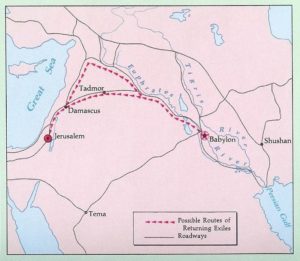
    The journey of the Israelites is quickly summed up in Ezra 2:1 by saying “They returned to Jerusalem…” but that was not as simple a journey as it sounds. That journey would have been close to 1,000 miles and would have taken several months. Here is a visual of the possible routes they may have taken to return to the Promised Land:


    Leave a Comment Below

    Did you learn something today? Share it with our Bible Reading Plan community by commenting below.

    Join the Team

    Interested in writing for the Bible Reading Plan? Email [email protected].

  • Ezra 1

    Ezra 1

    Getting Started

    Welcome to the Bible Reading Plan! We are so glad you are joining us for this journey through all ten chapters of Ezra over the next couple of weeks. Each day, you will read one chapter of the Bible followed by a short devotional, answer a few questions, and if you want, record any observations or insights using the interactive comments section. We believe God will use this resource to grow our knowledge and affection for Him. We know God’s Word does not return void (Isaiah 55:11). Sign up with a friend, your Life Group, or your family, and let’s dig in!

    Make sure to download our Harris Creek App and turn on push notifications, or visit us at biblereadingplan.org and sign up to receive the BRP in your inbox. Also, don’t forget to follow us on Instagram (@harriscreek) for some fun, creative ways to interact with the readings. 

    Let’s Go, Church!

    Ezra Preview

    The books of Ezra and Nehemiah, much like 1 and 2 Samuel, originally started off as one long story that was eventually split up into two separate books. Ezra, which came first, covers a span of roughly 90 years, beginning in 538 B.C. following the original destruction of the first Jewish temple. After decades of exile in Babylon, it was time for God’s people, the Israelites, to return to Jerusalem and rebuild the temple. Enter Ezra and Nehemiah.

    These two books fall under the category of a historical book, similar to Joshua or 1 and 2 Samuel. Ezra and Nehemiah are interesting reads because they tell us different parts of a story that can, at times, appear somewhat unresolved. While you read, parts may even feel anticlimactic. So why are these two books important? These books give us a guide to revival within God’s people. It’s far too common to let apathy and the desire to go through the motions creep into our lives, our small groups, and our churches. Ezra and Nehemiah both call the people of God towards spiritual revitalization, and there is much we can learn from their stories.

    As we read, grab a journal and take good notes. What do these chapters teach you about God’s character? What does it teach you about humanity? What are the implications for you today? We have said it before, but it’s important to remember the significance of these Old Testament books. Too often we get confused by the Old Testament because some of the names sound funny and because we equate “old” with “irrelevant.” There are so many things we can learn about God and ourselves through the lens of this book. As we read the book of Ezra (and then Nehemiah), start each day with a prayer asking God to open your heart to what you need to learn today. Thanks for reading along with us! 

    Read Ezra 1

    Cyrus Helps the Exiles to Return

    In the first year of Cyrus king of Persia, in order to fulfill the word of the Lord spoken by Jeremiah, the Lord moved the heart of Cyrus king of Persia to make a proclamation throughout his realm and also to put it in writing:

    “This is what Cyrus king of Persia says:

    “‘The Lord, the God of heaven, has given me all the kingdoms of the earth and he has appointed me to build a temple for him at Jerusalem in Judah. Any of his people among you may go up to Jerusalem in Judah and build the temple of the Lord, the God of Israel, the God who is in Jerusalem, and may their God be with them. And in any locality where survivors may now be living, the people are to provide them with silver and gold, with goods and livestock, and with freewill offerings for the temple of God in Jerusalem.’”

    Then the family heads of Judah and Benjamin, and the priests and Levites—everyone whose heart God had moved—prepared to go up and build the house of the Lord in Jerusalem. All their neighbors assisted them with articles of silver and gold, with goods and livestock, and with valuable gifts, in addition to all the freewill offerings.

    Moreover, King Cyrus brought out the articles belonging to the temple of the Lord, which Nebuchadnezzar had carried away from Jerusalem and had placed in the temple of his god. Cyrus king of Persia had them brought by Mithredath the treasurer, who counted them out to Sheshbazzar the prince of Judah.

    This was the inventory:

    gold dishes30
    silver dishes1,000
    silver pans29
    10 gold bowls30
    matching silver bowls410
    other articles1,000

    11 In all, there were 5,400 articles of gold and of silver. Sheshbazzar brought all these along with the exiles when they came up from Babylon to Jerusalem.

    Go Deeper

    Ezra 1 introduces us to a notable person and a notable group of people. While this book is named after Ezra, we won’t actually meet him until chapter 7. The first person we’re introduced to is King Cyrus, the new Persian king in the first year of his reign. The Jews had lived in exile for decades, and finally, the new king was allowing them to return home. Not only did King Cyrus allow them to return to Jerusalem, he also gave them an important instruction—go rebuild the temple. 

    The notable group of people we meet next are the Israelites—God’s people. For some, this was an answered prayer! For others, the news was met with a shrug. Many were comfortable with their new lives in their new lands. The idea of going to Jerusalem to build a temple wasn’t appealing—they would rather just stay where they were. But for some, Scripture tells us that their hearts were moved (v. 5). Those who were ready to go back to Jerusalem were a minority, but they were a faithful minority. As we have seen time and time again throughout Scripture, you can never underestimate what God can do through a faithful group of people. They loaded up their belongings and made the trek back to Jerusalem to begin working on the task at hand. 

    So, what can we learn from these faithful few? They were obedient when God started moving in their hearts. Oftentimes we feel that same stirring—our hearts are moved—yet we don’t respond with full obedience because it requires us to give up something. While exiled, Israelites built homes and established livelihoods. To return to Jerusalem meant sacrificing comfort and their new normal, but God stirred their hearts and the faithful responded with obedience. As we go about our day today, pay attention to those nudges from God. He could nudge us to pray for a person whose name comes to mind, to call or text a friend, or he could move our hearts to respond to a need. It may not be as drastic as uprooting your family (although it could be), but obedience is God’s expectation every time. 

    Questions

    1. Why do you think so many of the Israelites in exile didn’t want to go back to Jerusalem?
    2. When was the last time God moved your heart? How did you respond? 
    3. What does this chapter teach you about God? What does it teach you about humanity?

    Did You Know?

    Curious why King Cyrus was so willing to send the Israelites home to Jerusalem? According to Josephus, the first century Jewish historian, Cyrus was familiar with the prophecies about him found in Isaiah 44 and 45. Whether or not he was a follower of Yahweh we can’t know for sure, but he had seen enough evidence of God to implore God’s people to rebuild the temple.

    Leave a Comment Below

    Did you learn something today? Share it with our Bible Reading Plan community by commenting below.

    Join the Team

    Interested in writing for the Bible Reading Plan? Email [email protected].

  • Rest Day 21

    Rest Day 21

    Rest Day

    Today is a Rest Day. There is no new Bible reading to do. Today, the goal is simple: rest in the presence of God. Maybe you need to use today to get caught up on the reading plan if you’re behind, maybe you want to journal what you’re learning so you don’t forget what God is teaching you, or maybe you want to spend time in concentrated prayer–do that. Above all, just spend time in God’s presence. Each Rest Day, we will also introduce a memory verse for the week. Meditate on this week’s verse and begin to memorize it.

    Memory Verse

    I lift up my eyes to the mountains—
        where does my help come from?
    My help comes from the Lord,
        the Maker of heaven and earth.

    Psalm 121:1-2

    Memorization Tip

    Who says Scripture memorization has to be boring? Make it a game! Write the verse out on notecards, a different word for each card. Then, shuffle them around and place them back in the correct order from memory.

    Worship with Us

    Join us at 9a, 11a, or 7p in person or online at harriscreek.org/live. We’d love to worship with you! We also desire to connect everyone with a local church body where they can thrive in community and use their gifts to serve. If you’re following our Bible Reading Plan from outside of Waco and are eager to get connected with a great local church, email us at [email protected].

    Leave a Comment Below
    Did you learn something today? Share it with our Bible Reading Plan community by commenting below.
  • Psalm 125

    Psalm 125

    Read Psalm 125

    A song of ascents.

    Those who trust in the Lord are like Mount Zion,
        which cannot be shaken but endures forever.
    As the mountains surround Jerusalem,
        so the Lord surrounds his people
        both now and forevermore.

    The scepter of the wicked will not remain
        over the land allotted to the righteous,
    for then the righteous might use
        their hands to do evil.

    Lord, do good to those who are good,
        to those who are upright in heart.
    But those who turn to crooked ways
        the Lord will banish with the evildoers.

    Peace be on Israel.

    Go Deeper

    For most of us, the consistent uncertainty of the world feels unlike any other time in our lives. It can feel like the only thing that is predictable is the unpredictability of the world around us. This has led to record high cases of anxiety and depression. Whenever we feel unsettled or insecure, Psalm 125 is a good reminder of how big and dependable our God is.  

    If you have ever spent time near the Rocky Mountains (or any other mountain range), you know how majestic they are up close. The psalmist tells us that when we put our trust in the Lord, we become strong, steady, and faithful like a mountain. We cannot be moved because we trust in the One True God who cannot be moved. Because we rely upon an omniscient, omnipotent, and omnipresent God, we can have confidence that He surrounds us, constantly ready to provide protection (Psalm 34:19), guidance (Proverbs 3:5-6), and His Presence (Matthew 28:20).  

    A scepter is a symbol of an earthly sovereign. The Israelites had been promised the holy land as their inheritance. In verse 3, the psalmist is reminding the Israelites that their inheritance will not always be controlled by the wicked and will be kept safe from the potential sin of those who purport to be righteous. Our inheritance is controlled and given by the Lord. Psalm 16:5 says, “Lord, you have assigned me my portion and my cup; you have made my lot secure.” 

    We may sometimes get discouraged because it seems that the wicked are “running the show” and getting ahead, but here the psalmist reminds us that the wicked will not always have their way, and the righteous will receive their promised inheritance from the Lord. 1 Peter 1:3-5 communicates the same promise “…He has given us new birth into a living hope through the resurrection of Jesus Christ from the dead, and into an inheritance that can never perish, spoil or fade. This inheritance is kept in heaven for you, who through faith are shielded by God’s power until the coming of the salvation that is ready to be revealed in the last time.”  

    Questions

    1. Do you struggle with worrying about the future? Why (or why not)?
    2. Do you really believe that what the Lord has in store for us who believe in Christ will “never perish, spoil, or fade” and is being “kept in heaven for you?”
    3. Remind yourself that the Bible, as God’s Word, is either true and trustworthy or it is false. If you believe that it’s true, what comforts can you find from today’s reading? 

    A Quote

    “The saints abide forever, but their troubles do not.”  

    Charles Spurgeon

    Leave a Comment Below

    Did you learn something today? Share it with our Bible Reading Plan community by commenting below.

    Join the Team

    Interested in writing for the Bible Reading Plan? Email [email protected].

  • Psalm 124

    Psalm 124

    Read Psalm 124

    A song of ascents. Of David.

    If the Lord had not been on our side—
        let Israel say—
    if the Lord had not been on our side
        when people attacked us,
    they would have swallowed us alive
        when their anger flared against us;
    the flood would have engulfed us,
        the torrent would have swept over us,
    the raging waters
        would have swept us away.

    Praise be to the Lord,
        who has not let us be torn by their teeth.
    We have escaped like a bird
        from the fowler’s snare;
    the snare has been broken,
        and we have escaped.
    Our help is in the name of the Lord,
        the Maker of heaven and earth.

    Go Deeper

    Some days, the brokenness of this world seems too much to bear. Too much hate, too much pain, too much loss, too much conflict…it can all feel like just too much. This is not a new condition for humankind and will not be an old condition until the eternal restoration of heaven on earth. So what are we supposed to do in the meantime? How do we cope with the chaos and conflict?

    David and the people of Israel offer guidance in Psalm 124. The nation of Israel understood conflict. They endured pain and loss (see enslavement in Egypt and the aftermath in Exodus). They had been at war with their neighbors for generations and had kings in conflict with each other (see 1 and 2 Samuel). They lived in fear of famine, invasion, and deadly illness daily. Yet, they sang Psalm 124.

    This psalm begins with an introduction and call to community worship. Can’t you hear the piano’s low and slow start of melody as the worship leader steps to the microphone and gratefully sings “If the Lord had not been on our side…” Everyone knows this song; we were raised on it, sang it at church camp, heard our grandparents sing it, and the intro ushers all the trials, triumphs, and trust in God that comes from His faithfulness to bring us through the brokenness of this world. The tears swell in our eyes and the peace pours over us as we let go of controlling the things of this world and grab hold of the joy of the Lord that can come only from the Holy Spirit.

    “Let all of Israel say” the worship leader calls to us. This is not an isolated request; it is a group effort to share the stories, claim the promises, and demonstrate the Holy Spirit to a tired and broken nation. This is a call to us when this world is too much. The psalm describes how God saved Israel from the perils of this world. It ends with the joint proclamation, “Our help is in the name of the Lord, the Maker of heaven and earth.” May we find peace and comfort in making this same proclamation together with our community, “Our help is in the name of the Lord, the Maker of heaven and earth.”

    Questions

    1. What are the things of this world that make you feel overwhelmed today?
    2. According to Psalm 124, what can we proclaim when feeling overwhelmed by the world’s brokenness?
    3. Psalm 124 is a community worship song for Israel to remind them of God’s care for them. What worship song reminds you of God’s care?

    Listen Here

    Spend some time today listening to songs of worship that reflect the message of Psalm 124 with this playlist on Spotify.

    Leave a Comment Below

    Did you learn something today? Share it with our Bible Reading Plan community by commenting below.

    Join the Team

    Interested in writing for the Bible Reading Plan? Email [email protected].

  • Psalm 123

    Psalm 123

    Read Psalm 123

    A song of ascents.

    I lift up my eyes to you,
        to you who sit enthroned in heaven.
    As the eyes of slaves look to the hand of their master,
        as the eyes of a female slave look to the hand of her mistress,
    so our eyes look to the Lord our God,
        till he shows us his mercy.

    Have mercy on us, Lord, have mercy on us,
        for we have endured no end of contempt.
    We have endured no end
        of ridicule from the arrogant,
        of contempt from the proud.

    Go Deeper

    No matter where we are, some form of hierarchy is at play all around us. At the bank, the teller answers to the bank president. On an airplane, the flight attendant takes direction from the captain. At the pool, the lifeguard with the whistle reigns over the waters, even if that lifeguard is a teenager. We inherently acknowledge and respect hierarchies of authority. And within those rules, sometimes written and sometimes unwritten, we have expectations of how all parties should act. 

    In Psalm 123, we see four different relationships at play, each with different expectations. The writer opens the psalm by looking up to God enthroned in heaven. That’s one relationship. Then he compares his own posture to a slave looking up to his master, or a maidservant looking up to her master. That’s three relationships. Man and God, a male slave and his slave owner, and a maidservant and her mistress. The fourth relationship is revealed in verse 4, when we discover that the people of God have endured contempt and ridicule from the proud, presumably from neighboring nations or those who reject the truth of God. One people group ridicules another people group. That’s four relationships. 

    The cry of the psalmist, and the underlying motivation for writing this psalm, is for God to show Israel mercy. Our God is unique. His character is unique. We serve a God who offers mercy, who is marked by his merciful nature. He’s different from the slavemaster. He’s different from the strong nation mocking the rival nation. God does not proudly mock nor does He abuse His authority. He breaks the world’s expectations. We can be confident of His mercy because He has displayed it for generations. We serve a merciful God, even as we are subservient to Him. 

    Questions

    1. Think about the relationships in all facets of your life (work, church, family, community). How would you classify the hierarchies in those relationships? 
    2. In times of guilt or suffering, where are you tempted to turn other than God?
    3. When you cry out to God, what do you expect?

    Listen Here

    This is a song from John Mark Pantana called “Made for Jesus”. Let this song flood over your heart today as a prayer of gratitude.

    Leave a Comment Below

    Did you learn something today? Share it with our Bible Reading Plan community by commenting below.

    Join the Team

    Interested in writing for the Bible Reading Plan? Email [email protected].

  • Psalm 122

    Psalm 122

    Read Psalm 122

    A song of ascents. Of David.

    I rejoiced with those who said to me,
        “Let us go to the house of the Lord.”
    Our feet are standing
        in your gates, Jerusalem.

    Jerusalem is built like a city
        that is closely compacted together.
    That is where the tribes go up—
        the tribes of the Lord
    to praise the name of the Lord
        according to the statute given to Israel.
    There stand the thrones for judgment,
        the thrones of the house of David.

    Pray for the peace of Jerusalem:
        “May those who love you be secure.
    May there be peace within your walls
        and security within your citadels.”
    For the sake of my family and friends,
        I will say, “Peace be within you.”
    For the sake of the house of the Lord our God,
        I will seek your prosperity.

    Go Deeper

    After a long pilgrimage, the Jewish people were at the gates of their beloved Jerusalem. The temple in Jerusalem would be the resting place of the Ark of the Covenant and the throne of King David. With glad hearts, they said: “Let us go to the House of the Lord!” What a glorious time this must have been as they celebrated the priestly worship of God in the temple, as well as the kingly reverence of God at the throne of David. Their long pilgrimage had ended and it was time to gather for worship in the “House of the Lord”. 

    The past couple of years have taught us many things, but one of the most notable is the importance of worshipping corporately alongside other believers. We know the church is not a building, but the assembly of God’s people gathered together. There is something undeniably powerful about gathering with the body of Christ for worship, prayer, fellowship, communion, baptisms and preaching.

    Since Christ ascended back to Heaven, the body of Christ (His church) has gathered regularly for preaching, prayer, fellowship, communion, confession, and songs. It’s why Old Testament scholar Derek Kinder said; “What Jerusalem was to the Israelites, the Church is to the Christian.” Or in the words of 14th Century theologian Martin Luther: “Our Jerusalem is the Church and our temple is Christ. Wherever Christ is preached and the sacraments are rightly administered, there we are sure God dwells and there is our temple, our tabernacle, our cherubim, and our mercy seat. For there, God is present with us by His Word.”

    The good news for the church today is Jesus is the true King. He reigns in His holy temple, full of glory and honor, and is worthy of our praise. May we gather as the people of God each week with our churches, lifting our voices in song and prayer, receiving communion, celebrating baptisms, hearts filled with the Holy Spirit, and minds renewed by the preaching of the Word.  


    Questions

    1. Gathering for worship each week is such a privilege and freedom we have in Christ.  What aspect of gathered worship do you cherish the most?
    2. How would you describe the difference between a weekly small group and the weekly assembly of God’s people? Why are they both so important to our spiritual worship and discipleship?
    3. Have you ever found yourself going through the motions during a Sunday gathering? How can you prevent your heart from treating it as just part of your weekly routine?

    Pray This

    Father, thank you for the freedom and ability to gather together with the body of Christ to lift high your name. We repent for the times we have gone through the motions or treated it as a box to check. Help me center my heart on you. Thank you for your Church. In Jesus’ name, Amen. 

    Leave a Comment Below

    Did you learn something today? Share it with our Bible Reading Plan community by commenting below.

    Join the Team

    Interested in writing for the Bible Reading Plan? Email [email protected].

  • Psalm 121

    Psalm 121

    Read Psalm 121

    A song of ascents.

    I lift up my eyes to the mountains—
        where does my help come from?
    My help comes from the Lord,
        the Maker of heaven and earth.

    He will not let your foot slip—
        he who watches over you will not slumber;
    indeed, he who watches over Israel
        will neither slumber nor sleep.

    The Lord watches over you—
        the Lord is your shade at your right hand;
    the sun will not harm you by day,
        nor the moon by night.

    The Lord will keep you from all harm—
        he will watch over your life;
    the Lord will watch over your coming and going
        both now and forevermore.

    Go Deeper

    Psalm 121 is the second song of ascent and is believed to have been sung as pilgrims approached Jerusalem. The city, which is located up on a hill, was the site of numerous festivals. The first verse can be interpreted literally as the author is looking upon the physical hill in front of him and mentally preparing for the journey, but also metaphorically in the sense of remembering the trials that they have gone through in their life so far. With both interpretations, the message stays the same: The Lord guides through it all.

    It’s after this proclamation of who God is in verse 2 that there is a shift in focus, from the speaker’s personal problems to focusing on who God is, now directly addressing the reader. We don’t hear the author complain about the journey or what else they are worried about, because when they approached a difficult journey, they immediately went to remembering what is true about who God is. When we take our eyes off of ourselves and instead remember who God is, it changes how we view everything, our circumstances, ourselves, and others all look different with this change in vision.

    So what does the author see when he looks to God? That He is watching over us and helps us stay firm (v. 3). He does not forget us or turn His back on us –even when it feels like he does (v. 4). He helps us see clearly and has a plan for our life that is better than what we could plan (v. 5 & 7). This can all be summed up by the Hebrew word shamar, meaning to keep and preserve. It’s repeated six times throughout this chapter to clearly communicate that The Lord will preserve you. Even when we are doubting and turning away from God, He is constant and steady (v. 8).

    We are often so quick to turn away from God when things get hard. It’s easy to be overwhelmed by the world and to try to take control, but what we are being reminded of in this passage is that God is enough. While we are not enough for the trials we go through, the good news for us is that our God is more than enough! Take time today to meditate on these truths of who God is.

    Questions

    1. What are all the words you see repeated in this chapter? What are some of the recurring themes?
    2. What did you learn about God in this chapter?
    3. The final verse says “ the Lord will watch over your coming and going both now and forevermore.” How does this make you feel?

    Listen Here

    A great song to help remind you who God is is Highlands (Song of Ascent) by Hillsong United. Here’s the link to the song on YouTube!

    Leave a Comment Below

    Did you learn something today? Share it with our Bible Reading Plan community by commenting below.

    Join the Team

    Interested in writing for the Bible Reading Plan? Email [email protected].

  • Psalm 120

    Psalm 120

    Read Psalm 120

    A song of ascents.

    I call on the Lord in my distress,
        and he answers me.
    Save me, Lord,
        from lying lips
        and from deceitful tongues.

    What will he do to you,
        and what more besides,
        you deceitful tongue?
    He will punish you with a warrior’s sharp arrows,
        with burning coals of the broom bush.

    Woe to me that I dwell in Meshek,
        that I live among the tents of Kedar!
    Too long have I lived
        among those who hate peace.
    I am for peace;
        but when I speak, they are for war.

    EDITOR’S NOTE

    Psalms 120-134 are known as the “Psalms of Ascent” or “Pilgrim Songs”. Every year as the Jews traveled uphill towards the city of Jerusalem to participate in one of the three Jewish festivals, these are the songs they would sing. They became a staple of the pilgrimage to Jerusalem back then and now they serve as a helpful template for us as we worship today. 

    Go Deeper

    Psalm 120 is a prayer, written by David, asking for deliverance from the plans and actions of treacherous people. David starts his prayer by declaring the faithfulness of God. This is probably no accident, as he is seeking deliverance from the faithlessness and betrayal of others. David starts where we should, in times when people not only let us down, but cause us great harm. He reminds himself that God can be trusted, even when those closest to us, or those that surround us, cannot. 

    Psalm 120 not only serves as a prayer and a cry for help; it can also act as a warning and source of wisdom. To those with deceitful tongues, David describes the consequences of their actions as arrows and burning coals of the broom tree. In the footnotes of Psalm 120, The Amplified Bible tells us that the coals of broom trees are peculiar in that they can continue to smolder on the inside long after they appear to have died out on the outside. In the same way, the aftermath of deceit continues to linger in our hearts and lives long after lies are told. 

    Let us, as the people of God, be instead known for our faithfulness and truthfulness.

    A final word of encouragement, if you find yourself in the aftermath of others’ deceit: We serve a God who knows firsthand the pain of treachery. This psalm points us to the life of Jesus, who, in His mercy and grace, is able to bear witness to and comfort us in our heartache and suffering. Take courage: God is faithful, even when the people around us are not.

    Questions

    1. Can you relate to the pain of David in this psalm? Have you ever experienced the treachery of others?
    2. Have you ever caused pain by deceit and betrayal? There is grace for you in Jesus. You can find forgiveness and freedom from your sin in Christ. 
    3. Are you in a position to support or bring comfort and encouragement to those who are struggling with the pain described in the psalm? Can you remind them of the faithfulness of God in the midst of their pain? 

    Keep Digging

    Curious about the role of broom trees, or “juniper,” throughout Scripture? Check this out.

    Leave a Comment Below

    Did you learn something today? Share it with our Bible Reading Plan community by commenting below.

    Join the Team

    Interested in writing for the Bible Reading Plan? Email [email protected].