
Read Ezra 2
The List of the Exiles Who Returned
2 Now these are the people of the province who came up from the captivity of the exiles, whom Nebuchadnezzar king of Babylon had taken captive to Babylon (they returned to Jerusalem and Judah, each to their own town, 2 in company with Zerubbabel, Joshua, Nehemiah, Seraiah,Reelaiah, Mordecai, Bilshan, Mispar, Bigvai, Rehum and Baanah):
The list of the men of the people of Israel:
| 3 the descendants of Parosh | 2,172 |
| 4 of Shephatiah | 372 |
| 5 of Arah | 775 |
| 6 of Pahath-Moab (through the line of Jeshua and Joab) | 2,812 |
| 7 of Elam | 1,254 |
| 8 of Zattu | 945 |
| 9 of Zakkai | 760 |
| 10 of Bani | 642 |
| 11 of Bebai | 623 |
| 12 of Azgad | 1,222 |
| 13 of Adonikam | 666 |
| 14 of Bigvai | 2,056 |
| 15 of Adin | 454 |
| 16 of Ater (through Hezekiah) | 98 |
| 17 of Bezai | 323 |
| 18 of Jorah | 112 |
| 19 of Hashum | 223 |
| 20 of Gibbar | 95 |
| 21 the men of Bethlehem | 123 |
| 22 of Netophah | 56 |
| 23 of Anathoth | 128 |
| 24 of Azmaveth | 42 |
| 25 of Kiriath Jearim, Kephirah and Beeroth | 743 |
| 26 of Ramah and Geba | 621 |
| 27 of Mikmash | 122 |
| 28 of Bethel and Ai | 223 |
| 29 of Nebo | 52 |
| 30 of Magbish | 156 |
| 31 of the other Elam | 1,254 |
| 32 of Harim | 320 |
| 33 of Lod, Hadid and Ono | 725 |
| 34 of Jericho | 345 |
| 35 of Senaah | 3,630 |
36 The priests:
| the descendants of Jedaiah (through the family of Jeshua) | 973 |
| 37 of Immer | 1,052 |
| 38 of Pashhur | 1,247 |
| 39 of Harim | 1,017 |
40 The Levites:
| the descendants of Jeshua and Kadmiel (of the line of Hodaviah) | 74 |
41 The musicians:
| the descendants of Asaph | 128 |
42 The gatekeepers of the temple:
| the descendants of | |
| Shallum, Ater, Talmon, | |
| Akkub, Hatita and Shobai | 139 |
43 The temple servants:
| the descendants of |
| Ziha, Hasupha, Tabbaoth, |
| 44 Keros, Siaha, Padon, |
| 45 Lebanah, Hagabah, Akkub, |
| 46 Hagab, Shalmai, Hanan, |
| 47 Giddel, Gahar, Reaiah, |
| 48 Rezin, Nekoda, Gazzam, |
| 49 Uzza, Paseah, Besai, |
| 50 Asnah, Meunim, Nephusim, |
| 51 Bakbuk, Hakupha, Harhur, |
| 52 Bazluth, Mehida, Harsha, |
| 53 Barkos, Sisera, Temah, |
| 54 Neziah and Hatipha |
55 The descendants of the servants of Solomon:
| the descendants of |
| Sotai, Hassophereth, Peruda, |
| 56 Jaala, Darkon, Giddel, |
| 57 Shephatiah, Hattil, |
| Pokereth-Hazzebaim and Ami |
| 58 The temple servants and the descendants of the servants of Solomon | 392 |
59 The following came up from the towns of Tel Melah, Tel Harsha, Kerub, Addon and Immer, but they could not show that their families were descended from Israel:
| 60 The descendants of | |
| Delaiah, Tobiah and Nekoda | 652 |
61 And from among the priests:
| The descendants of |
| Hobaiah, Hakkoz and Barzillai (a man who had married a daughter of Barzillai the Gileadite and was called by that name). |
62 These searched for their family records, but they could not find them and so were excluded from the priesthood as unclean. 63 The governor ordered them not to eat any of the most sacred food until there was a priest ministering with the Urim and Thummim.
64 The whole company numbered 42,360, 65 besides their 7,337 male and female slaves; and they also had 200 male and female singers.66 They had 736 horses, 245 mules, 67 435 camels and 6,720 donkeys.
68 When they arrived at the house of the Lord in Jerusalem, some of the heads of the families gave freewill offerings toward the rebuilding of the house of God on its site. 69 According to their ability they gave to the treasury for this work 61,000 darics of gold, 5,000 minas of silver and 100 priestly garments.
70 The priests, the Levites, the musicians, the gatekeepers and the temple servants settled in their own towns, along with some of the other people, and the rest of the Israelites settled in their towns.
Go Deeper
This chapter of Ezra is a historical narrative listing the names and numbers of the families that returned to Israel after 70 years of exile in Babylon. Passages of Scripture like this typically elicit one sort of reaction to readers: boring. But before we skim past these 70 verses of Scripture and allow our eyes to cross from the long names and longer numbers, let’s remember who these people were and where they were coming from.
Ezra 2:1 tells us “Now these were the people of the province who came up out of the captivity…”. Seventy years earlier, God had punished the Israelites for their unfaithfulness and sent them into exile. These people returning included those who had experienced the exile firsthand as well as their offspring who had been told by their fathers and grandfathers where to return after their captivity.
Verse 64 states that “The whole assembly together was 42,360…” so around 50,000 people are returning to Jerusalem and Judah. It’s important to note that this is a small number compared to the half a million people who once lived in Jerusalem. We will learn in later passages of Scripture that this was the first of 3 waves of people returning from captivity, but even so, there were tens of thousands of Israelites who never returned to the Promised Land. We can make assumptions about those who didn’t return: that they were too comfortable in their new surroundings or possibly too afraid of what might await them in their old surroundings. The names listed in this passage of Scripture, though, represent family after family who obediently returned to help rebuild the temple and properly restore worship in Israel and their names are eternally recorded as a result of their obedience.
This group of people is not only remembered for obedience in returning to the Promised Land, but they are also remembered for their contributions to the rebuilding of the temple. Ezra 2:68 says “… when they came to the house of the Lord that is in Jerusalem, (they) made freewill offerings for the house of God, to erect it on its site.” A freewill offering was given voluntarily and was given as the Lord moved the hearts of the Israelites. So these Israelites took a faithful first step of obedience by traveling hundreds of miles back to their homeland, and once they got there, they continued to be obedient in giving to the Lord of their resources for His glory.
So instead of labeling Ezra 2 as an irrelevant and boring genealogy, we can thank God for each of the names listed in this chapter because they are examples to us of obedience and sacrificial giving. They are heroes of our own faith. Glance back at one of the verses, pick a name, and praise God for their faithfulness. What a gracious God we serve that He has provided us with such precision and details!
Questions
- Psalm 37:23 says “The Lord directs the steps of the godly. He delights in every detail of their lives.” Ezra 2 is an example of this. Spend some time thanking God that He cares about the details of your life!
- Is there a step of obedience that you need to take the first step in like the Israelites did in returning to the Promised Land?
- The Holy Spirit can move our hearts just as He moved the hearts of the Israelites to give freely. Ask God to help you be in tune with where to steward your time, money, and resources.
Dig Deeper
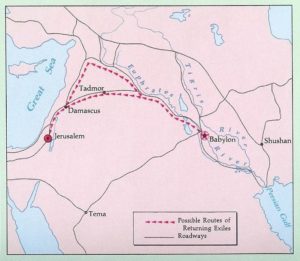
The journey of the Israelites is quickly summed up in Ezra 2:1 by saying “They returned to Jerusalem…” but that was not as simple a journey as it sounds. That journey would have been close to 1,000 miles and would have taken several months. Here is a visual of the possible routes they may have taken to return to the Promised Land:
Leave a Comment Below
Join the Team
Interested in writing for the Bible Reading Plan? Email [email protected].