
Read Nehemiah 3
Builders of the Wall
Eliashib the high priest and his fellow priests went to work and rebuilt the Sheep Gate. They dedicated it and set its doors in place, building as far as the Tower of the Hundred, which they dedicated, and as far as the Tower of Hananel. 2 The men of Jericho built the adjoining section, and Zakkur son of Imri built next to them.
3 The Fish Gate was rebuilt by the sons of Hassenaah. They laid its beams and put its doors and bolts and bars in place. 4 Meremoth son of Uriah, the son of Hakkoz, repaired the next section. Next to him Meshullam son of Berekiah, the son of Meshezabel, made repairs, and next to him Zadok son of Baana also made repairs. 5 The next section was repaired by the men of Tekoa, but their nobles would not put their shoulders to the work under their supervisors.
6 The Jeshanah Gate was repaired by Joiada son of Paseah and Meshullam son of Besodeiah. They laid its beams and put its doors with their bolts and bars in place. 7 Next to them, repairs were made by men from Gibeon and Mizpah—Melatiah of Gibeon and Jadon of Meronoth—places under the authority of the governor of Trans-Euphrates. 8 Uzziel son of Harhaiah, one of the goldsmiths, repaired the next section; and Hananiah, one of the perfume-makers, made repairs next to that. They restored Jerusalem as far as the Broad Wall. 9 Rephaiah son of Hur, ruler of a half-district of Jerusalem, repaired the next section. 10 Adjoining this, Jedaiah son of Harumaph made repairs opposite his house, and Hattush son of Hashabneiah made repairs next to him. 11 Malkijah son of Harim and Hasshub son of Pahath-Moab repaired another section and the Tower of the Ovens. 12 Shallum son of Hallohesh, ruler of a half-district of Jerusalem, repaired the next section with the help of his daughters.
13 The Valley Gate was repaired by Hanun and the residents of Zanoah. They rebuilt it and put its doors with their bolts and bars in place. They also repaired a thousand cubits of the wall as far as the Dung Gate.
14 The Dung Gate was repaired by Malkijah son of Rekab, ruler of the district of Beth Hakkerem. He rebuilt it and put its doors with their bolts and bars in place.
15 The Fountain Gate was repaired by Shallun son of Kol-Hozeh, ruler of the district of Mizpah. He rebuilt it, roofing it over and putting its doors and bolts and bars in place. He also repaired the wall of the Pool of Siloam, by the King’s Garden, as far as the steps going down from the City of David. 16 Beyond him, Nehemiah son of Azbuk, ruler of a half-district of Beth Zur, made repairs up to a point opposite the tombs of David, as far as the artificial pool and the House of the Heroes.
17 Next to him, the repairs were made by the Levites under Rehum son of Bani. Beside him, Hashabiah, ruler of half the district of Keilah, carried out repairs for his district. 18 Next to him, the repairs were made by their fellow Levites under Binnuif]”>[f] son of Henadad, ruler of the other half-district of Keilah. 19 Next to him, Ezer son of Jeshua, ruler of Mizpah, repaired another section, from a point facing the ascent to the armory as far as the angle of the wall. 20 Next to him, Baruch son of Zabbai zealously repaired another section, from the angle to the entrance of the house of Eliashib the high priest. 21 Next to him, Meremoth son of Uriah, the son of Hakkoz, repaired another section, from the entrance of Eliashib’s house to the end of it.
22 The repairs next to him were made by the priests from the surrounding region. 23 Beyond them, Benjamin and Hasshub made repairs in front of their house; and next to them, Azariah son of Maaseiah, the son of Ananiah, made repairs beside his house. 24 Next to him, Binnui son of Henadad repaired another section, from Azariah’s house to the angle and the corner, 25 and Palal son of Uzai worked opposite the angle and the tower projecting from the upper palace near the court of the guard. Next to him, Pedaiah son of Parosh 26 and the temple servants living on the hill of Ophel made repairs up to a point opposite the Water Gate toward the east and the projecting tower. 27 Next to them, the men of Tekoa repaired another section, from the great projecting tower to the wall of Ophel.
28 Above the Horse Gate, the priests made repairs, each in front of his own house. 29 Next to them, Zadok son of Immer made repairs opposite his house. Next to him, Shemaiah son of Shekaniah, the guard at the East Gate, made repairs. 30 Next to him, Hananiah son of Shelemiah, and Hanun, the sixth son of Zalaph, repaired another section. Next to them, Meshullam son of Berekiah made repairs opposite his living quarters. 31 Next to him, Malkijah, one of the goldsmiths, made repairs as far as the house of the temple servants and the merchants, opposite the Inspection Gate, and as far as the room above the corner; 32 and between the room above the corner and the Sheep Gate the goldsmiths and merchants made repairs.
Go Deeper
As you read this chapter, you might have thought that a map would have been helpful. There are many names and instructions that are included. The Bible Knowledge Series by John Wavoord and Roy Zuck emphasize Nehemiah’s skill of delegation. This pushes us to ask the question: What is the relationship between the people and the section of wall they are delegated to build?
People were assigned to build near their houses. Nehemiah knew that people would care more about the wall in front of their house rather than the wall on the other side of the city. Wavoord and Zuck offer other reasons for this purposeful delegation which include: “the people would waste less time traveling, the people would be less likely to flee in the event of an attack, and the whole family would have the opportunity to contribute.” All in all, people were designated to segments of the wall that they would care more about.
What does this mean to us? As the church, we should be mindful of where we build. It would have been inefficient, poorly executed, and negligent if the people would have built a part of the wall they did not care about. As we build relationships, form connections, and outreach, we should be mindful of where we focus our energy. God purposely put you where you are. With that in mind, we should not neglect our surroundings. We should be intentional and purposeful in the places and with the people we see everyday.. Lastly, we should keep in mind that even though each group was working on their own section of the wall, they were working on one final project.
This seems to mirror our ministry as the church. We are uniquely connected to co-workers, friend groups, and family. We should remind ourselves that Jesus sends us into the world to build but we (the church) are all working on one project: Building the Kingdom of God.
Questions
- Think about where God has you today. Why do you think He placed you there?
- How do you see what you are doing in your community and how that relates to the Kingdom of God?
- What does this chapter teach you about Nehemiah? What does it teach you about God?
Dig Deeper
Are you trying to visualize exactly what the wall looked like? Check out this helpful map! 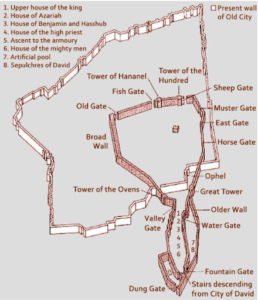
Leave a Comment Below
Join the Team
Interested in writing for the Bible Reading Plan? Email [email protected].

7 responses to “Nehemiah 3”
The Sheep Gate is mentioned first. An interesting thought/read was” The Sheep Gate represents the first step in our life with Christ. It represents the realization that Jesus Christ is the Lamb of God and represents how Christ was sacrificed for our sins on the Cross.
The Sheep Gate is the first gate mentioned and the last gate mentioned which is symbolic that everything begins and ends with the Cross.”
Each gate represents protection of God’s dwelling place. The detail of all the different gates and what they represent is making a more complete picture of how God is protecting us.” In Nehemiah 3 we get a picture of God’s protective plan for His people. The wall will safeguard not just their physical lives but their relationship with Him.
Today God dwells in the hearts of believers making each of us a temple needing protection. Just as Nehemiah rebuilt walls around God’s dwelling place, we’re called to be strong walls and wise gatekeepers for those we love. And Jesus is the Gate through which we can always find our way back to God.”
“All scripture is inspired by God and is useful for teaching, for reproof, for correction, and for training in righteousness, so that everyone who belongs to God may be proficient, equipped for every good work.”
God thank You for showing me Your word in more and more detail. God You show me there is always more to learn about how, why, where, and what You have done and are doing. God thank You for me doing my part in helping You to build Your kingdom now. God thank You for being a doer of Your word. Thank You God for not listening to negative thoughts about what I cannot do but instead hear Your voice in what could be done in rebuilding the gates and walls. You have a purpose and a plan for every single person. God thank You for showing me details. Thank You God for the minutes of this day and the details within those minutes of how to glorify and honor You in all I say and do in Jesus name amen.
WOOHOO!!!!!!!!!!!!!!!!!!!!!!!!!!!!!!!!!!!!
That’s interesting about the Sheep Gate!
It’s fascinating the myriad of workers mentioned in this endeavor —high priests, fellow priests, men, goldsmiths, perfume makers, rulers and their daughters, residents—all engaged in seeing this community project to completion. I’m reminded that “work becomes worship when we dedicate it to God and perform it with an awareness of his presence.”
Today’s chapter was one of those readings that raised a lot of questions — and led to some intriguing answers and powerful applications.
ALL. THE. GATES.
Why did they need so many, and what was the meaning behind their names?
Each of Jerusalem’s gates marked both an economic function — and a spiritual reminder. For example:
• Sheep Gate. Animals for sacrifice entered here = “Access to God.”
• Fish Gate. Commercial hub = “Provision.”
• Dung Gate. Waste exit = “Repentance and cleansing.”
• Fountain Gate. Water source = “Life.”
• Horse Gate. Military access = “Strength & Defense.”
• Water Gate. Torah readings later happen here = “Renewal of the Word.”
These gates were “named theology.” In other words, the wall wasn’t just a barrier — it was a mapped confession of who God was to his people.
VERSE 5: “The leaders of Tekoa refused to work with the construction supervisors.” What’s up with that?
“The Hebrew implies prideful refusal to submit to oversight. AND their own people still worked anyway (v. 27).” Here we see leaders who would not bend, common people who did — and the contrast recorded for posterity.
VERSE 8: A goldsmith? A perfume manufacturer?
This tells us that wall-rebuilding wasn’t “blue-collar only” work — skill did not exempt anyone from service. Hands that normally handled precious metals and sacred fragrances are handling dust, sweat, and stones.
“The city is being rebuilt by people who smell like worship.“
VERSE 12: “With the help of his daughters.”
This is both completely unconventional — and absolutely intentional.
“The text names them because:
• women weren’t normally listed in labor registries
• daughters weren’t land inheritors
• but when Jerusalem needed healing — they showed up anyway.
It is holy disruption.”
VERSE 20: Baruch is the only person who gets an adverb: “zealously.”
This is a small detail that often gets overlooked. Scripture almost never uses adverbs for labor. And the Hebrew word used there is rare and intense. “Zealously” means “to glow, to burn, to blaze.”
Baruch’s name means blessed. But his identity becomes how he worked. This is God saying:
“This man did not just build— he BURNED.”
THE LISTING of leaders of regions, Levites and servants. It sounds like rank, role and station were not an issue. What might it have been like for people who normally did not mingle in the real world… to work “side by side?”
Levites. Priests. Governors. Merchants. Servants. This is a powerful picture of rank collapsed. Jerusalem rebuilt by people who normally would never share space… working shoulder to shoulder.
What a glorious illustration of Kingdom unity!
LINEAGE. So many men are named here as “sons of.”
This chapter reminds us that “what we rebuild today will have a name tomorrow. Lineage matters because memory matters. God is preserving the record of who chose to show up.
This is covenant DNA on display.”
ONE MORE “LIST.” Here we go again… one of those endless lists of people we don’t know with names we can’t pronounce.
But such “written tedium” serves to highlight the exceptions I’ve listed above.
While on the surface Nehemiah 3 looks like a genealogy chapter, it is much more alive than it first appears. Through it, God teaches that “restoration is not dramatic — it is faithful.
But when someone:
• refuses
• burns with zeal
• brings daughters
• crosses social lines
Those moments glow against the backdrop of ordinary obedience.
Nehemiah 3 is not a construction log. It is a relational map of a redeemed city.
A census of courage.
A choreography of unity.
A wall built by hearts before stones.”
17 “Next to him . . .”
The many repetitions of this phrase “next to him” is interesting to me. Along the lines of “a chain is only as strong as its weakest link”, likewise a wall is only as strong as its weakest section. It doesn’t do any good if I build my section well, but others don’t. We are dependent on each other’s work!
Great point!
Everyone, regardless of their status or skill set, had a part to play. Romans 12:4-5 reminds us, “For just as each of us has one body with many members, and these members do not all have the same function, so in Christ we, though many, form one body.” Recognize your unique role and contribute to the community.