
Category: Ezra

  • Ezra 3

    Ezra 3

    Read Ezra 3

    Rebuilding the Altar

    When the seventh month came and the Israelites had settled in their towns, the people assembled together as one in Jerusalem. Then Joshua son of Jozadak and his fellow priests and Zerubbabel son of Shealtiel and his associates began to build the altar of the God of Israel to sacrifice burnt offerings on it, in accordance with what is written in the Law of Moses the man of God. Despite their fear of the peoples around them, they built the altar on its foundation and sacrificed burnt offerings on it to the Lord, both the morning and evening sacrifices. Then in accordance with what is written, they celebrated the Festival of Tabernacles with the required number of burnt offerings prescribed for each day. After that, they presented the regular burnt offerings, the New Moon sacrifices and the sacrifices for all the appointed sacred festivals of the Lord, as well as those brought as freewill offerings to the Lord. On the first day of the seventh month they began to offer burnt offerings to the Lord, though the foundation of the Lord’s temple had not yet been laid.

    Rebuilding the Temple

    Then they gave money to the masons and carpenters, and gave food and drink and olive oil to the people of Sidon and Tyre, so that they would bring cedar logs by sea from Lebanon to Joppa, as authorized by Cyrus king of Persia.

    In the second month of the second year after their arrival at the house of God in Jerusalem, Zerubbabel son of Shealtiel, Joshua son of Jozadak and the rest of the people (the priests and the Levites and all who had returned from the captivity to Jerusalem) began the work. They appointed Levites twenty years old and older to supervise the building of the house of the Lord. Joshua and his sons and brothers and Kadmiel and his sons (descendants of Hodaviah) and the sons of Henadad and their sons and brothers—all Levites—joined together in supervising those working on the house of God.

    10 When the builders laid the foundation of the temple of the Lord, the priests in their vestments and with trumpets, and the Levites (the sons of Asaph) with cymbals, took their places to praise the Lord, as prescribed by David king of Israel. 11 With praise and thanksgiving they sang to the Lord:

    “He is good;
        his love toward Israel endures forever.”

    And all the people gave a great shout of praise to the Lord, because the foundation of the house of the Lord was laid. 12 But many of the older priests and Levites and family heads, who had seen the former temple, wept aloud when they saw the foundation of this temple being laid, while many others shouted for joy. 13 No one could distinguish the sound of the shouts of joy from the sound of weeping, because the people made so much noise. And the sound was heard far away.

    Go Deeper

    In this chapter, we see Zerubbabel leading the rebuilding of the temple. Over 42,000 Israelites returned to Jerusalem with him, and they immediately began work on the altar and the temple foundations. However, we see in verses 12 and 13 that this work was met with very different reactions. Those who had seen the original temple, the older priests and Levites, wept at the sight of the new foundation. Those helping to rebuild shouted for joy. Verse 13 tells us that the sounds of both were so loud you couldn’t distinguish one from the other.

    Isn’t it interesting that the same event would bring such polar opposite emotions? The shouts of joy are easy to understand. This sight was a symbol of obedience, a promise of hope, and the beginning of a new future. Even though this new temple was not going to be as elaborate or ornate as the original built by Solomon, it was a reminder of God’s protection and promises. 

    But for those who had lived through the years of disobedience and punishment, who had seen the destruction of Solomon’s temple, this new building elicited weeping and conviction. The original temple was surrounded by a thriving empire, while Zerubbabel’s temple was surrounded by ruins. For those who had lived through the destruction and fall of the original temple, the sight of this rebuild was a physical reminder of God’s correction and discipline – a reminder of their failures and shortcomings. It is no wonder there was such a range of emotions. Their individual responses had a direct correlation to whether their work was destroyed by sin or whether their work was a result of obedience. 

    Paul reminds us in 1 Corinthians 3 that we are now God’s temple, and just like the Israelites, our work will be tested on judgment day. Just as the new temple was built on the original foundation built by Solomon, we are now charged with building God’s kingdom upon the foundation of Jesus. Our work will be evaluated and either rewarded or discounted. 

    When that day comes and our kingdom work is looked upon, will we weep or will we shout for joy? Will the sight of it be a reminder of our sins or will it be a symbol of our obedience and God’s faithfulness? If we are honest, there will probably be some of both. Thankfully by God’s grace, we will be saved. Let’s get to work today building something that lasts, starting with a firm foundation in Jesus and continuing with materials that pass the test – obedience, love, and faithfulness to the God who has saved us. 

    Questions

    1. Do you think you will look back at your life and weep, or will you shout for joy?
    2. If you take an honest look at your life, have you established a firm foundation in Jesus?
    3. Spend some time praying and asking God what He is wanting you to do to build His kingdom. What specific step is He asking you to take in obedience? If you feel Him prompting you, consider sharing that with someone who will help hold you accountable.

    By the Way

    Haggai addressed those who were weeping in Ezra 3 and comforted them by prophesying that the glory of this new temple would exceed the glory of the former, because Jesus was going to come and fill it with His glory! See Haggai 2:7, written around 520 B.C.

    Leave a Comment Below

    Did you learn something today? Share it with our Bible Reading Plan community by commenting below.

    Join the Team

    Interested in writing for the Bible Reading Plan? Email [email protected].
  • Ezra 2

    Ezra 2

    Read Ezra 2

    The List of the Exiles Who Returned

    Now these are the people of the province who came up from the captivity of the exiles, whom Nebuchadnezzar king of Babylon had taken captive to Babylon (they returned to Jerusalem and Judah, each to their own town, in company with Zerubbabel, Joshua, Nehemiah, Seraiah,Reelaiah, Mordecai, Bilshan, Mispar, Bigvai, Rehum and Baanah):

    The list of the men of the people of Israel:

    the descendants of Parosh2,172
    of Shephatiah372
    of Arah775
    of Pahath-Moab (through the line of Jeshua and Joab)2,812
    of Elam1,254
    of Zattu945
    of Zakkai760
    10 of Bani642
    11 of Bebai623
    12 of Azgad1,222
    13 of Adonikam666
    14 of Bigvai2,056
    15 of Adin454
    16 of Ater (through Hezekiah)98
    17 of Bezai323
    18 of Jorah112
    19 of Hashum223
    20 of Gibbar95
    21 the men of Bethlehem123
    22 of Netophah56
    23 of Anathoth128
    24 of Azmaveth42
    25 of Kiriath Jearim, Kephirah and Beeroth743
    26 of Ramah and Geba621
    27 of Mikmash122
    28 of Bethel and Ai223
    29 of Nebo52
    30 of Magbish156
    31 of the other Elam1,254
    32 of Harim320
    33 of Lod, Hadid and Ono725
    34 of Jericho345
    35 of Senaah3,630

    36 The priests:

    the descendants of Jedaiah (through the family of Jeshua)973
    37 of Immer1,052
    38 of Pashhur1,247
    39 of Harim1,017

    40 The Levites:

    the descendants of Jeshua and Kadmiel (of the line of Hodaviah)74

    41 The musicians:

    the descendants of Asaph128

    42 The gatekeepers of the temple:

    the descendants of
    Shallum, Ater, Talmon,
    Akkub, Hatita and Shobai139

    43 The temple servants:

    the descendants of
    Ziha, Hasupha, Tabbaoth,
    44 Keros, Siaha, Padon,
    45 Lebanah, Hagabah, Akkub,
    46 Hagab, Shalmai, Hanan,
    47 Giddel, Gahar, Reaiah,
    48 Rezin, Nekoda, Gazzam,
    49 Uzza, Paseah, Besai,
    50 Asnah, Meunim, Nephusim,
    51 Bakbuk, Hakupha, Harhur,
    52 Bazluth, Mehida, Harsha,
    53 Barkos, Sisera, Temah,
    54 Neziah and Hatipha

    55 The descendants of the servants of Solomon:

    the descendants of
    Sotai, Hassophereth, Peruda,
    56 Jaala, Darkon, Giddel,
    57 Shephatiah, Hattil,
    Pokereth-Hazzebaim and Ami
    58 The temple servants and the descendants of the servants of Solomon392

    59 The following came up from the towns of Tel Melah, Tel Harsha, Kerub, Addon and Immer, but they could not show that their families were descended from Israel:

    60 The descendants of
    Delaiah, Tobiah and Nekoda652

    61 And from among the priests:

    The descendants of
    Hobaiah, Hakkoz and Barzillai (a man who had married a daughter of Barzillai the Gileadite and was called by that name).

    62 These searched for their family records, but they could not find them and so were excluded from the priesthood as unclean. 63 The governor ordered them not to eat any of the most sacred food until there was a priest ministering with the Urim and Thummim.

    64 The whole company numbered 42,360, 65 besides their 7,337 male and female slaves; and they also had 200 male and female singers.66 They had 736 horses, 245 mules, 67 435 camels and 6,720 donkeys.

    68 When they arrived at the house of the Lord in Jerusalem, some of the heads of the families gave freewill offerings toward the rebuilding of the house of God on its site. 69 According to their ability they gave to the treasury for this work 61,000 darics of gold, 5,000 minas of silver and 100 priestly garments.

    70 The priests, the Levites, the musicians, the gatekeepers and the temple servants settled in their own towns, along with some of the other people, and the rest of the Israelites settled in their towns.

    Go Deeper

    This chapter of Ezra is a historical narrative listing the names and numbers of the families that returned to Israel after 70 years of exile in Babylon. Passages of Scripture like this typically elicit one sort of reaction to readers: boring. But before we skim past these 70 verses of Scripture and allow our eyes to cross from the long names and longer numbers, let’s remember who these people were and where they were coming from.

    Ezra 2:1 tells us “Now these were the people of the province who came up out of the captivity…”. Seventy years earlier, God had punished the Israelites for their unfaithfulness and sent them into exile. These people returning included those who had experienced the exile firsthand as well as their offspring who had been told by their fathers and grandfathers where to return after their captivity. 

    Verse 64 states that “The whole assembly together was 42,360…” so around 50,000 people are returning to Jerusalem and Judah. It’s important to note that this is a small number compared to the half a million people who once lived in Jerusalem. We will learn in later passages of Scripture that this was the first of 3 waves of people returning from captivity, but even so, there were tens of thousands of Israelites who never returned to the Promised Land. We can make assumptions about those who didn’t return: that they were too comfortable in their new surroundings or possibly too afraid of what might await them in their old surroundings. The names listed in this passage of Scripture, though, represent family after family who obediently returned to help rebuild the temple and properly restore worship in Israel and their names are eternally recorded as a result of their obedience.

    This group of people is not only remembered for obedience in returning to the Promised Land, but they are also remembered for their contributions to the rebuilding of the temple. Ezra 2:68 says “… when they came to the house of the Lord that is in Jerusalem, (they) made freewill offerings for the house of God, to erect it on its site.” A freewill offering was given voluntarily and was given as the Lord moved the hearts of the Israelites. So these Israelites took a faithful first step of obedience by traveling hundreds of miles back to their homeland, and once they got there, they continued to be obedient in giving to the Lord of their resources for His glory.

    So instead of labeling Ezra 2 as an irrelevant and boring genealogy, we can thank God for each of the names listed in this chapter because they are examples to us of obedience and sacrificial giving. They are heroes of our own faith. Glance back at one of the verses, pick a name, and praise God for their faithfulness. What a gracious God we serve that He has provided us with such precision and details!  

    Questions

    1. Psalm 37:23 says “The Lord directs the steps of the godly. He delights in every detail of their lives.” Ezra 2 is an example of this. Spend some time thanking God that He cares about the details of your life!
    2. Is there a step of obedience that you need to take the first step in like the Israelites did in returning to the Promised Land?
    3. The Holy Spirit can move our hearts just as He moved the hearts of the Israelites to give freely. Ask God to help you be in tune with where to steward your time, money, and resources.  

    Dig Deeper

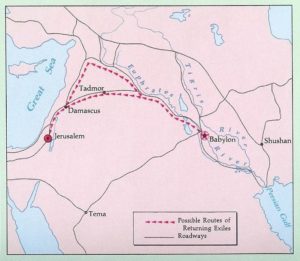
    The journey of the Israelites is quickly summed up in Ezra 2:1 by saying “They returned to Jerusalem…” but that was not as simple a journey as it sounds. That journey would have been close to 1,000 miles and would have taken several months. Here is a visual of the possible routes they may have taken to return to the Promised Land:


    Leave a Comment Below

    Did you learn something today? Share it with our Bible Reading Plan community by commenting below.

    Join the Team

    Interested in writing for the Bible Reading Plan? Email [email protected].

  • Ezra 1

    Ezra 1

    Getting Started

    Welcome to the Bible Reading Plan! We are so glad you are joining us for this journey through all ten chapters of Ezra over the next couple of weeks. Each day, you will read one chapter of the Bible followed by a short devotional, answer a few questions, and if you want, record any observations or insights using the interactive comments section. We believe God will use this resource to grow our knowledge and affection for Him. We know God’s Word does not return void (Isaiah 55:11). Sign up with a friend, your Life Group, or your family, and let’s dig in!

    Make sure to download our Harris Creek App and turn on push notifications, or visit us at biblereadingplan.org and sign up to receive the BRP in your inbox. Also, don’t forget to follow us on Instagram (@harriscreek) for some fun, creative ways to interact with the readings. 

    Let’s Go, Church!

    Ezra Preview

    The books of Ezra and Nehemiah, much like 1 and 2 Samuel, originally started off as one long story that was eventually split up into two separate books. Ezra, which came first, covers a span of roughly 90 years, beginning in 538 B.C. following the original destruction of the first Jewish temple. After decades of exile in Babylon, it was time for God’s people, the Israelites, to return to Jerusalem and rebuild the temple. Enter Ezra and Nehemiah.

    These two books fall under the category of a historical book, similar to Joshua or 1 and 2 Samuel. Ezra and Nehemiah are interesting reads because they tell us different parts of a story that can, at times, appear somewhat unresolved. While you read, parts may even feel anticlimactic. So why are these two books important? These books give us a guide to revival within God’s people. It’s far too common to let apathy and the desire to go through the motions creep into our lives, our small groups, and our churches. Ezra and Nehemiah both call the people of God towards spiritual revitalization, and there is much we can learn from their stories.

    As we read, grab a journal and take good notes. What do these chapters teach you about God’s character? What does it teach you about humanity? What are the implications for you today? We have said it before, but it’s important to remember the significance of these Old Testament books. Too often we get confused by the Old Testament because some of the names sound funny and because we equate “old” with “irrelevant.” There are so many things we can learn about God and ourselves through the lens of this book. As we read the book of Ezra (and then Nehemiah), start each day with a prayer asking God to open your heart to what you need to learn today. Thanks for reading along with us! 

    Read Ezra 1

    Cyrus Helps the Exiles to Return

    In the first year of Cyrus king of Persia, in order to fulfill the word of the Lord spoken by Jeremiah, the Lord moved the heart of Cyrus king of Persia to make a proclamation throughout his realm and also to put it in writing:

    “This is what Cyrus king of Persia says:

    “‘The Lord, the God of heaven, has given me all the kingdoms of the earth and he has appointed me to build a temple for him at Jerusalem in Judah. Any of his people among you may go up to Jerusalem in Judah and build the temple of the Lord, the God of Israel, the God who is in Jerusalem, and may their God be with them. And in any locality where survivors may now be living, the people are to provide them with silver and gold, with goods and livestock, and with freewill offerings for the temple of God in Jerusalem.’”

    Then the family heads of Judah and Benjamin, and the priests and Levites—everyone whose heart God had moved—prepared to go up and build the house of the Lord in Jerusalem. All their neighbors assisted them with articles of silver and gold, with goods and livestock, and with valuable gifts, in addition to all the freewill offerings.

    Moreover, King Cyrus brought out the articles belonging to the temple of the Lord, which Nebuchadnezzar had carried away from Jerusalem and had placed in the temple of his god. Cyrus king of Persia had them brought by Mithredath the treasurer, who counted them out to Sheshbazzar the prince of Judah.

    This was the inventory:

    gold dishes30
    silver dishes1,000
    silver pans29
    10 gold bowls30
    matching silver bowls410
    other articles1,000

    11 In all, there were 5,400 articles of gold and of silver. Sheshbazzar brought all these along with the exiles when they came up from Babylon to Jerusalem.

    Go Deeper

    Ezra 1 introduces us to a notable person and a notable group of people. While this book is named after Ezra, we won’t actually meet him until chapter 7. The first person we’re introduced to is King Cyrus, the new Persian king in the first year of his reign. The Jews had lived in exile for decades, and finally, the new king was allowing them to return home. Not only did King Cyrus allow them to return to Jerusalem, he also gave them an important instruction—go rebuild the temple. 

    The notable group of people we meet next are the Israelites—God’s people. For some, this was an answered prayer! For others, the news was met with a shrug. Many were comfortable with their new lives in their new lands. The idea of going to Jerusalem to build a temple wasn’t appealing—they would rather just stay where they were. But for some, Scripture tells us that their hearts were moved (v. 5). Those who were ready to go back to Jerusalem were a minority, but they were a faithful minority. As we have seen time and time again throughout Scripture, you can never underestimate what God can do through a faithful group of people. They loaded up their belongings and made the trek back to Jerusalem to begin working on the task at hand. 

    So, what can we learn from these faithful few? They were obedient when God started moving in their hearts. Oftentimes we feel that same stirring—our hearts are moved—yet we don’t respond with full obedience because it requires us to give up something. While exiled, Israelites built homes and established livelihoods. To return to Jerusalem meant sacrificing comfort and their new normal, but God stirred their hearts and the faithful responded with obedience. As we go about our day today, pay attention to those nudges from God. He could nudge us to pray for a person whose name comes to mind, to call or text a friend, or he could move our hearts to respond to a need. It may not be as drastic as uprooting your family (although it could be), but obedience is God’s expectation every time. 

    Questions

    1. Why do you think so many of the Israelites in exile didn’t want to go back to Jerusalem?
    2. When was the last time God moved your heart? How did you respond? 
    3. What does this chapter teach you about God? What does it teach you about humanity?

    Did You Know?

    Curious why King Cyrus was so willing to send the Israelites home to Jerusalem? According to Josephus, the first century Jewish historian, Cyrus was familiar with the prophecies about him found in Isaiah 44 and 45. Whether or not he was a follower of Yahweh we can’t know for sure, but he had seen enough evidence of God to implore God’s people to rebuild the temple.

    Leave a Comment Below

    Did you learn something today? Share it with our Bible Reading Plan community by commenting below.

    Join the Team

    Interested in writing for the Bible Reading Plan? Email [email protected].