
Blog

  • Ezra 7

    Ezra 7

    Read Ezra 7

    Ezra Comes to Jerusalem

    After these things, during the reign of Artaxerxes king of Persia, Ezra son of Seraiah, the son of Azariah, the son of Hilkiah, the son of Shallum, the son of Zadok, the son of Ahitub, the son of Amariah, the son of Azariah, the son of Meraioth, the son of Zerahiah, the son of Uzzi, the son of Bukki, the son of Abishua, the son of Phinehas, the son of Eleazar, the son of Aaron the chief priest— this Ezra came up from Babylon. He was a teacher well versed in the Law of Moses, which the Lord, the God of Israel, had given. The king had granted him everything he asked, for the hand of the Lord his God was on him. Some of the Israelites, including priests, Levites, musicians, gatekeepers and temple servants, also came up to Jerusalem in the seventh year of King Artaxerxes.

    Ezra arrived in Jerusalem in the fifth month of the seventh year of the king. He had begun his journey from Babylon on the first day of the first month, and he arrived in Jerusalem on the first day of the fifth month, for the gracious hand of his God was on him. 10 For Ezra had devoted himself to the study and observance of the Law of the Lord, and to teaching its decrees and laws in Israel.

    King Artaxerxes’ Letter to Ezra

    11 This is a copy of the letter King Artaxerxes had given to Ezra the priest, a teacher of the Law, a man learned in matters concerning the commands and decrees of the Lord for Israel:

    12 Artaxerxes, king of kings,

    To Ezra the priest, teacher of the Law of the God of heaven:

    Greetings.

    13 Now I decree that any of the Israelites in my kingdom, including priests and Levites, who volunteer to go to Jerusalem with you, may go. 14 You are sent by the king and his seven advisers to inquire about Judah and Jerusalem with regard to the Law of your God, which is in your hand. 15 Moreover, you are to take with you the silver and gold that the king and his advisers have freely given to the God of Israel, whose dwelling is in Jerusalem, 16 together with all the silver and gold you may obtain from the province of Babylon, as well as the freewill offerings of the people and priests for the temple of their God in Jerusalem. 17 With this money be sure to buy bulls, rams and male lambs, together with their grain offerings and drink offerings, and sacrifice them on the altar of the temple of your God in Jerusalem.

    18 You and your fellow Israelites may then do whatever seems best with the rest of the silver and gold, in accordance with the will of your God. 19 Deliver to the God of Jerusalem all the articles entrusted to you for worship in the temple of your God. 20 And anything else needed for the temple of your God that you are responsible to supply, you may provide from the royal treasury.

    21 Now I, King Artaxerxes, decree that all the treasurers of Trans-Euphrates are to provide with diligence whatever Ezra the priest, the teacher of the Law of the God of heaven, may ask of you— 22 up to a hundred talents of silver, a hundred cors of wheat, a hundred baths of wine, a hundred baths of olive oil, and salt without limit. 23 Whatever the God of heaven has prescribed, let it be done with diligence for the temple of the God of heaven. Why should his wrath fall on the realm of the king and of his sons? 24 You are also to know that you have no authority to impose taxes, tribute or duty on any of the priests, Levites, musicians, gatekeepers, temple servants or other workers at this house of God.

    25 And you, Ezra, in accordance with the wisdom of your God, which you possess, appoint magistrates and judges to administer justice to all the people of Trans-Euphrates—all who know the laws of your God. And you are to teach any who do not know them. 26 Whoever does not obey the law of your God and the law of the king must surely be punished by death, banishment, confiscation of property, or imprisonment.

    27 Praise be to the Lord, the God of our ancestors, who has put it into the king’s heart to bring honor to the house of the Lord in Jerusalem in this way 28 and who has extended his good favor to me before the king and his advisers and all the king’s powerful officials. Because the hand of the Lord my God was on me, I took courage and gathered leaders from Israel to go up with me.

    Go Deeper

    The events of today’s reading take place roughly 60 years after chapter six. We finally meet Ezra! King Artaxerxes commissions Ezra, who is estimated to be only 22 years old at this point, to lead any of the Israelites in exile who desire to go back to Jerusalem. King Artaxerxes is beyond generous. He entrusts Ezra with silver and gold for the temple, encourages offerings for the temple, and even offers “whatever else is required for the house of your God… you may provide it out of the king’s treasury” (v. 20). It doesn’t stop there. He appoints Ezra to select judges that will enforce God’s law. He encourages Ezra to teach the Scriptures to all the exiles in Jerusalem. Not only is this a huge responsibility and honor for Ezra, but also unheard of for the king to make these sorts of commands!

    Immediately after reading the letter, Ezra responds by praising God for moving in the king’s heart. He knows God is working in every single detail of the king’s commissioning (Proverbs 21:1). Ezra proclaims in verse 28: “I took courage, for the hand of the Lord my God was on me!” He gives all credit to God! We see Ezra’s courage come not from his status as a gifted scribe, his approval from the king, or his age—but from the Lord. 

    Ezra sets an incredible example for believers. We see in verse 10 that “Ezra had set his heart to study the Law of the Lord, and to do it and to teach his statues and rules in Israel.” He was determined to know God’s Word, to do what it says, and to teach it to others. His time with the Father overflowed into all he did. Even King Artaxerxes noticed Ezra’s godly wisdom and entrusted the leadership and finances of Jerusalem into his hands. 

    Today, may we be spurred on by Ezra’s faithfulness and devote ourselves to spending time with God in His Word, doing what He says, and teaching it to others. May our confidence and identity be rooted in Christ instead of our age, status, or circumstances. Finally, today may we take heart, because the same God who was working in all the details in Ezra 7 is on the move in our lives and world today!

    Questions

    1. Ezra “had set his heart” to know God’s Word. What spiritual disciplines do you have in place to do the same? 
    2. Not only was Ezra determined to study God’s Word, but to actively do what it said. James 1:22 states, But don’t just listen to God’s word. You must do what it says. Otherwise, you are only fooling yourselves.” In what ways are you practically living out the Scripture you are studying? 
    3. Throughout our reading today, we were able to see God working behind the decisions the king made. God is the same yesterday, today, and forever! (Hebrews 13:8) He is actively working in our world today, too. How are you praying for our country’s leadership? 

    Did You Know?

    Ezra and his traveling companions left Babylon during the Jewish month of Nisan. Nisan corresponds to our late March/early April. It took their group four months to cover the 900 mile journey.

    Leave a Comment Below

    Did you learn something today? Share it with our Bible Reading Plan community by commenting below.

    Join the Team

    Interested in writing for the Bible Reading Plan? Email [email protected].

  • Ezra 6

    Ezra 6

    Read Ezra 6

    The Decree of Darius

    King Darius then issued an order, and they searched in the archives stored in the treasury at Babylon. A scroll was found in the citadel of Ecbatana in the province of Media, and this was written on it:

    Memorandum:

    In the first year of King Cyrus, the king issued a decree concerning the temple of God in Jerusalem:

    Let the temple be rebuilt as a place to present sacrifices, and let its foundations be laid. It is to be sixty cubits high and sixty cubits wide, with three courses of large stones and one of timbers. The costs are to be paid by the royal treasury. Also, the gold and silver articles of the house of God, which Nebuchadnezzar took from the temple in Jerusalem and brought to Babylon, are to be returned to their places in the temple in Jerusalem; they are to be deposited in the house of God.

    Now then, Tattenai, governor of Trans-Euphrates, and Shethar-Bozenai and you other officials of that province, stay away from there. Do not interfere with the work on this temple of God. Let the governor of the Jews and the Jewish elders rebuild this house of God on its site.

    Moreover, I hereby decree what you are to do for these elders of the Jews in the construction of this house of God:

    Their expenses are to be fully paid out of the royal treasury, from the revenues of Trans-Euphrates, so that the work will not stop. Whatever is needed—young bulls, rams, male lambs for burnt offerings to the God of heaven, and wheat, salt, wine and olive oil, as requested by the priests in Jerusalem—must be given them daily without fail, 10 so that they may offer sacrifices pleasing to the God of heaven and pray for the well-being of the king and his sons.

    11 Furthermore, I decree that if anyone defies this edict, a beam is to be pulled from their house and they are to be impaled on it. And for this crime their house is to be made a pile of rubble. 12 May God, who has caused his Name to dwell there, overthrow any king or people who lifts a hand to change this decree or to destroy this temple in Jerusalem.

    I Darius have decreed it. Let it be carried out with diligence.

    Completion and Dedication of the Temple

    13 Then, because of the decree King Darius had sent, Tattenai, governor of Trans-Euphrates, and Shethar-Bozenai and their associates carried it out with diligence. 14 So the elders of the Jews continued to build and prosper under the preaching of Haggai the prophet and Zechariah, a descendant of Iddo. They finished building the temple according to the command of the God of Israel and the decrees of Cyrus, Darius and Artaxerxes, kings of Persia. 15 The temple was completed on the third day of the month Adar, in the sixth year of the reign of King Darius.

    16 Then the people of Israel—the priests, the Levites and the rest of the exiles—celebrated the dedication of the house of God with joy. 17 For the dedication of this house of God they offered a hundred bulls, two hundred rams, four hundred male lambs and, as a sin offering for all Israel, twelve male goats, one for each of the tribes of Israel. 18 And they installed the priests in their divisions and the Levites in their groups for the service of God at Jerusalem, according to what is written in the Book of Moses.

    The Passover

    19 On the fourteenth day of the first month, the exiles celebrated the Passover. 20 The priests and Levites had purified themselves and were all ceremonially clean. The Levites slaughtered the Passover lamb for all the exiles, for their relatives the priests and for themselves. 21 So the Israelites who had returned from the exile ate it, together with all who had separated themselves from the unclean practices of their Gentile neighbors in order to seek the Lord, the God of Israel. 22 For seven days they celebrated with joy the Festival of Unleavened Bread, because the Lord had filled them with joy by changing the attitude of the king of Assyria so that he assisted them in the work on the house of God, the God of Israel.

    Go Deeper

    If Ezra 6 was a movie we’d be on the edge of our seat, leaning in, waiting for the fist-pump-in-the-air celebration of the ending. On first reading it, we might miss the drama of it all, but look again: a lost letter of declaration found; the powerful opposition rendered powerless becoming the solution and resource to accomplish the work of the Israelites; an unlikely, ungodly advocate and defender of God’s people; a 21-year project completed; and a 70-year-old prophecy fulfilled. Sit with the drama, the weight, the excitement of it all.

    To understand the excitement of it all, we need a little background. Psalm 137 reminds us of the despair of the exiles. The pain of being away from their home. “By the rivers of Babylon we sat and wept when we remembered Zion (Jerusalem)…how can we sing the songs of the Lord while in a foreign land?” They lived as aliens and foreigners in a place that was not their home. Yet, they longed for home and for God to fulfill His promise to them—that He would bring them back to Jerusalem. 

    God always pays for what He orders. About 70 years prior, God said (through his prophet Jeremiah), “When seventy years are completed for Babylon, I will come to you and fulfill my good promise to bring you back to this place.” Ezra 6 is the culmination of years of waiting. God is a promise-keeping, way-making God, who is faithful to the faithless and rebuilds places, dreams, and people out of ruins. Imagine the wonder and the buzz and the excitement when the final stone was put in place and the people of God were home again. No wonder the word joy is mentioned so often in this chapter. 

    What can we learn from Ezra 6? God is faithful to keep His promises. He hasn’t forgotten us. The work we get to do on this side of heaven is met with opposition and obstacles, but God will often use unlikely and unexpected people and circumstances to fulfill the work He has for us. Our faithfulness to sacred work matters and it will often be harder and require more patience than we thought. And one day, we, too, will experience the joy of being home. Until then, let’s do the work and trust Him to complete it. 

    Questions

    1. What surprises you about this chapter? 
    2. What do you learn about the character of God? What do you learn about the character of man? 
    3. How are you experiencing God’s faithfulness? Is there a situation or circumstance where you need God to move on your behalf? Answer both of these questions in a prayer to Him.

    Did You Know?

    Isaiah 44:28 says, “Who says of Cyrus, ‘He is my shepherd and will accomplish all that I please; he will say of Jerusalem, “Let it be rebuilt,” and of the temple, “Let its foundations be laid.”  These prophetic words were written 100 years before the events in Ezra 6. This prophecy confounds those who make it their mission to dispute the authenticity of the Bible. They cannot understand or make sense of how a King—who had not even been born—is NAMED 100 years before his rule.

    Leave a Comment Below

    Did you learn something today? Share it with our Bible Reading Plan community by commenting below.

    Join the Team

    Interested in writing for the Bible Reading Plan? Email [email protected].
  • Rest Day + Family Guide (2 Chronicles 36-Ezra 5)

    Rest Day + Family Guide (2 Chronicles 36-Ezra 5)

    Rest Day

    Each Sunday is a Rest Day. There is no new Bible reading to do. Today, the goal is simple: rest in the presence of God. Maybe you need to use today to get caught up on the reading plan if you’re behind, maybe you want to journal what you’re learning so you don’t forget what God is teaching you, or maybe you want to spend time in concentrated prayer–do that. Above all, just spend time in God’s presence.

    Each Rest Day, we will have an additional element to help you dig deeper. Sometimes it will be extra resources to further your study, a video to watch, or a podcast to listen to. Sometimes we’ll have a verse to commit to memorize to help you hide God’s Word in your heart. 

    If you have kids, our Family Guide will help you discuss what you’re reading and learning with them! It’s a great opportunity for your family to read God’s Word together and review what we read the previous week!

    Keep Digging

    Check out this helpful resource from The Bible Project for the book of Ezra (and Nehemiah)!

    Family Guide

    Check out this week’s 2 Chronicles 36-Ezra 5 Family Guide!

  • Ezra 5

    Ezra 5

    Read Ezra 5

    Tattenai’s Letter to Darius

    Now Haggai the prophet and Zechariah the prophet, a descendant of Iddo, prophesied to the Jews in Judah and Jerusalem in the name of the God of Israel, who was over them. Then Zerubbabel son of Shealtiel and Joshua son of Jozadak set to work to rebuild the house of God in Jerusalem. And the prophets of God were with them, supporting them.

    At that time Tattenai, governor of Trans-Euphrates, and Shethar-Bozenai and their associates went to them and asked, “Who authorized you to rebuild this temple and to finish it?” They also asked, “What are the names of those who are constructing this building?” But the eye of their God was watching over the elders of the Jews, and they were not stopped until a report could go to Darius and his written reply be received.

    This is a copy of the letter that Tattenai, governor of Trans-Euphrates, and Shethar-Bozenai and their associates, the officials of Trans-Euphrates, sent to King Darius. The report they sent him read as follows:

    To King Darius:

    Cordial greetings.

    The king should know that we went to the district of Judah, to the temple of the great God. The people are building it with large stones and placing the timbers in the walls. The work is being carried on with diligence and is making rapid progress under their direction.

    We questioned the elders and asked them, “Who authorized you to rebuild this temple and to finish it?” 10 We also asked them their names, so that we could write down the names of their leaders for your information.

    11 This is the answer they gave us:

    “We are the servants of the God of heaven and earth, and we are rebuilding the temple that was built many years ago, one that a great king of Israel built and finished. 12 But because our ancestors angered the God of heaven, he gave them into the hands of Nebuchadnezzar the Chaldean, king of Babylon, who destroyed this temple and deported the people to Babylon.

    13 “However, in the first year of Cyrus king of Babylon, King Cyrus issued a decree to rebuild this house of God. 14 He even removed from the temple of Babylon the gold and silver articles of the house of God, which Nebuchadnezzar had taken from the temple in Jerusalem and brought to the temple in Babylon. Then King Cyrus gave them to a man named Sheshbazzar, whom he had appointed governor, 15 and he told him, ‘Take these articles and go and deposit them in the temple in Jerusalem. And rebuild the house of God on its site.’

    16 “So this Sheshbazzar came and laid the foundations of the house of God in Jerusalem. From that day to the present it has been under construction but is not yet finished.”

    17 Now if it pleases the king, let a search be made in the royal archives of Babylon to see if King Cyrus did in fact issue a decree to rebuild this house of God in Jerusalem. Then let the king send us his decision in this matter.

    Go Deeper

    In order to better understand this chapter, we need to first remember how the previous chapter ended. King Artaxerxes had just ordered the people of God to stop rebuilding the temple, and, for about 10 years, the project had come to a “standstill” (v. 24). However, chapter 5 begins with a brand new hope for the rebuilding efforts. Haggai and Zechariah have prophesied to the Jewish people and encouraged them to restart on the mission of building the temple. But once the project begins again, the project once more runs into opposition from the governing authorities. This external threat is a discouraging reminder of what kept the temple from being built in the first place. This obstruction effort is an essential lesson for the people of God. As we seek to faithfully follow God, we should not expect to live our lives unopposed by the enemy.  When God calls on His people to complete a task, we should expect Satan to do whatever he can to keep the task from reaching its fulfillment. 

    In Ezra, the opposition comes in the form of the ruling government. But even those leaders who stood in authority weren’t the ones in ultimate control.  While the governor tried to shut the project down, the eye of their God was watching over the elders of the Jews, and they were not stopped” (v. 5). Upon receiving push back, the Jewish people could have easily put down their tools just as they did 10 years before. However, this time they decide to continue, in courageous faith, with their mission. 

    An essential lesson from this chapter that can impact our lives today is that resistance doesn’t mean something is wrong. If it feels difficult to obediently follow Jesus, remember that it should be expected more than it should be surprising. While Jesus promised that His burden is easy, He also asks us to pick up our cross each day. Even though we may encounter external or internal opposition to following God, we have the assurance that the eyes of God are watching over us. Today, we have an opportunity similar to that of the Jewish people: In the face of resistance, we don’t need to put faithfulness on pause. Instead, we can double down on obedience and choose to follow God even when it’s difficult.  

    Why do you think the Jewish people were willing to continue working on this mission in the face of resilience? 

    Questions

    1. What most sticks out to you in the letter to King Darius? 
    2. Where do you feel like you are receiving resistance in your attempt to follow God? 
    3. What can you do to make sure you don’t give up in the face of such resistance? 

    Did You Know?

    Both prophets listed in verse 1 (Haggai and Zechariah) have written books of the Bible. To read more about their life and message, check out the books titled with their names! 

    Leave a Comment Below

    Did you learn something today? Share it with our Bible Reading Plan community by commenting below.

    Join the Team

    Interested in writing for the Bible Reading Plan? Email [email protected].

  • Ezra 4

    Ezra 4

    Read Ezra 4

    Opposition to the Rebuilding

    When the enemies of Judah and Benjamin heard that the exiles were building a temple for the Lord, the God of Israel, they came to Zerubbabel and to the heads of the families and said, “Let us help you build because, like you, we seek your God and have been sacrificing to him since the time of Esarhaddon king of Assyria, who brought us here.”

    But Zerubbabel, Joshua and the rest of the heads of the families of Israel answered, “You have no part with us in building a temple to our God. We alone will build it for the Lord, the God of Israel, as King Cyrus, the king of Persia, commanded us.”

    Then the peoples around them set out to discourage the people of Judah and make them afraid to go on building. They bribed officials to work against them and frustrate their plans during the entire reign of Cyrus king of Persia and down to the reign of Darius king of Persia.

    Later Opposition Under Xerxes and Artaxerxes

    At the beginning of the reign of Xerxes, they lodged an accusation against the people of Judah and Jerusalem.

    And in the days of Artaxerxes king of Persia, Bishlam, Mithredath, Tabeel and the rest of his associates wrote a letter to Artaxerxes. The letter was written in Aramaic script and in the Aramaic language.

    Rehum the commanding officer and Shimshai the secretary wrote a letter against Jerusalem to Artaxerxes the king as follows:

    Rehum the commanding officer and Shimshai the secretary, together with the rest of their associates—the judges, officials and administrators over the people from Persia, Uruk and Babylon, the Elamites of Susa, 10 and the other people whom the great and honorable Ashurbanipal deported and settled in the city of Samaria and elsewhere in Trans-Euphrates.

    11 (This is a copy of the letter they sent him.)

    To King Artaxerxes,

    From your servants in Trans-Euphrates:

    12 The king should know that the people who came up to us from you have gone to Jerusalem and are rebuilding that rebellious and wicked city. They are restoring the walls and repairing the foundations.

    13 Furthermore, the king should know that if this city is built and its walls are restored, no more taxes, tribute or duty will be paid, and eventually the royal revenues will suffer. 14 Now since we are under obligation to the palace and it is not proper for us to see the king dishonored, we are sending this message to inform the king, 15 so that a search may be made in the archives of your predecessors. In these records you will find that this city is a rebellious city, troublesome to kings and provinces, a place with a long history of sedition. That is why this city was destroyed. 16 We inform the king that if this city is built and its walls are restored, you will be left with nothing in Trans-Euphrates.

    17 The king sent this reply:

    To Rehum the commanding officer, Shimshai the secretary and the rest of their associates living in Samaria and elsewhere in Trans-Euphrates:

    Greetings.

    18 The letter you sent us has been read and translated in my presence. 19 I issued an order and a search was made, and it was found that this city has a long history of revolt against kings and has been a place of rebellion and sedition. 20 Jerusalem has had powerful kings ruling over the whole of Trans-Euphrates, and taxes, tribute and duty were paid to them. 21 Now issue an order to these men to stop work, so that this city will not be rebuilt until I so order. 22 Be careful not to neglect this matter. Why let this threat grow, to the detriment of the royal interests?

    23 As soon as the copy of the letter of King Artaxerxes was read to Rehum and Shimshai the secretary and their associates, they went immediately to the Jews in Jerusalem and compelled them by force to stop.

    24 Thus the work on the house of God in Jerusalem came to a standstill until the second year of the reign of Darius king of Persia.

    Go Deeper

    We all know what it’s like to face distractions that pull us off task. Sometimes, the distractions come from things like social media, phone calls, and text messages. We can’t seem to focus on the task in front of us because of the constant barrage of thoughts in our heads. Other times, they come from people who seem to interrupt us at the most inopportune times (all parents immediately think of their children!).

    We also know what it’s like to face opposition. There are days when it seems like the universe is conspiring against us as we seek to get through the list of demands we have on any given day. Even the writing of this Bible Reading Plan devotional was delayed multiple times by random distractions and points of opposition!

    We’re no different than God’s people. In Ezra 4, we see they have returned home from exile and are on task to rebuild the wall (Nehemiah) and temple (largely Ezra). As promised, God allowed His people to return from captivity to the Promised Land. Now that they’re back home, the people hope to resume the normal day-to-day activities of life in their homeland.

    As they begin rebuilding the temple, God’s people face distraction and opposition from both internal and external sources. In Ezra 4:1-5, we see God’s enemies initiate a fake friendship with the exiles. They pretend to want to help rebuild the temple. Israel’s leaders wisely told their enemies they didn’t want or need their help. During their rebuilding efforts, internal opposition seeks to pull them off course. These enemies of God showed their true colors by discouraging the people of Judah, raising fears, and bribing officials to work against them. God’s people also faced opposition from the outside. Letters were written that led to what was probably a 16-18 year delay in the rebuilding of the temple.

    Any good and worthy deed faces distractions and oppositions. What can you do today to deal with any distractions and opposition in front of you so that you can do the good works God has prepared in advance for you to do (Ephesians 2:10)?

    Questions

    1. Why do you think God’s people wanted to rebuild the temple?
    2. What are some distractions you face today that are working to pull you off task?
    3. What can you learn from God’s people on how to deal with your distractions and opposition?

    Pray This

    God, today we know we will face many barriers and challenges. We take comfort in the fact that You are not surprised by anything we will face. Help us to say no to the wrong things and yes to the right ones so that we can do the work you have prepared in advance for us to do. Give us discerning hearts to judge between right and wrong. We confess that on our own, we are hopeless and can do nothing (John 15:5), so help us to rightly work through any distractions and obstacles that will come our way today. Amen. 

    Leave a Comment Below

    Did you learn something today? Share it with our Bible Reading Plan community by commenting below.

    Join the Team

    Interested in writing for the Bible Reading Plan? Email [email protected].

  • Ezra 3

    Ezra 3

    Read Ezra 3

    Rebuilding the Altar

    When the seventh month came and the Israelites had settled in their towns, the people assembled together as one in Jerusalem. Then Joshua son of Jozadak and his fellow priests and Zerubbabel son of Shealtiel and his associates began to build the altar of the God of Israel to sacrifice burnt offerings on it, in accordance with what is written in the Law of Moses the man of God. Despite their fear of the peoples around them, they built the altar on its foundation and sacrificed burnt offerings on it to the Lord, both the morning and evening sacrifices. Then in accordance with what is written, they celebrated the Festival of Tabernacles with the required number of burnt offerings prescribed for each day. After that, they presented the regular burnt offerings, the New Moon sacrifices and the sacrifices for all the appointed sacred festivals of the Lord, as well as those brought as freewill offerings to the Lord. On the first day of the seventh month they began to offer burnt offerings to the Lord, though the foundation of the Lord’s temple had not yet been laid.

    Rebuilding the Temple

    Then they gave money to the masons and carpenters, and gave food and drink and olive oil to the people of Sidon and Tyre, so that they would bring cedar logs by sea from Lebanon to Joppa, as authorized by Cyrus king of Persia.

    In the second month of the second year after their arrival at the house of God in Jerusalem, Zerubbabel son of Shealtiel, Joshua son of Jozadak and the rest of the people (the priests and the Levites and all who had returned from the captivity to Jerusalem) began the work. They appointed Levites twenty years old and older to supervise the building of the house of the Lord. Joshua and his sons and brothers and Kadmiel and his sons (descendants of Hodaviah) and the sons of Henadad and their sons and brothers—all Levites—joined together in supervising those working on the house of God.

    10 When the builders laid the foundation of the temple of the Lord, the priests in their vestments and with trumpets, and the Levites (the sons of Asaph) with cymbals, took their places to praise the Lord, as prescribed by David king of Israel. 11 With praise and thanksgiving they sang to the Lord:

    “He is good;
        his love toward Israel endures forever.”

    And all the people gave a great shout of praise to the Lord, because the foundation of the house of the Lord was laid. 12 But many of the older priests and Levites and family heads, who had seen the former temple, wept aloud when they saw the foundation of this temple being laid, while many others shouted for joy. 13 No one could distinguish the sound of the shouts of joy from the sound of weeping, because the people made so much noise. And the sound was heard far away.

    Go Deeper

    In this chapter, we see Zerubbabel leading the rebuilding of the temple. Over 42,000 Israelites returned to Jerusalem with him, and they immediately began work on the altar and the temple foundations. However, we see in verses 12 and 13 that this work was met with very different reactions. Those who had seen the original temple, the older priests and Levites, wept at the sight of the new foundation. Those helping to rebuild shouted for joy. Verse 13 tells us that the sounds of both were so loud you couldn’t distinguish one from the other.

    Isn’t it interesting that the same event would bring such polar opposite emotions? The shouts of joy are easy to understand. This sight was a symbol of obedience, a promise of hope, and the beginning of a new future. Even though this new temple was not going to be as elaborate or ornate as the original built by Solomon, it was a reminder of God’s protection and promises. 

    But for those who had lived through the years of disobedience and punishment, who had seen the destruction of Solomon’s temple, this new building elicited weeping and conviction. The original temple was surrounded by a thriving empire, while Zerubbabel’s temple was surrounded by ruins. For those who had lived through the destruction and fall of the original temple, the sight of this rebuild was a physical reminder of God’s correction and discipline – a reminder of their failures and shortcomings. It is no wonder there was such a range of emotions. Their individual responses had a direct correlation to whether their work was destroyed by sin or whether their work was a result of obedience. 

    Paul reminds us in 1 Corinthians 3 that we are now God’s temple, and just like the Israelites, our work will be tested on judgment day. Just as the new temple was built on the original foundation built by Solomon, we are now charged with building God’s kingdom upon the foundation of Jesus. Our work will be evaluated and either rewarded or discounted. 

    When that day comes and our kingdom work is looked upon, will we weep or will we shout for joy? Will the sight of it be a reminder of our sins or will it be a symbol of our obedience and God’s faithfulness? If we are honest, there will probably be some of both. Thankfully by God’s grace, we will be saved. Let’s get to work today building something that lasts, starting with a firm foundation in Jesus and continuing with materials that pass the test – obedience, love, and faithfulness to the God who has saved us. 

    Questions

    1. Do you think you will look back at your life and weep, or will you shout for joy?
    2. If you take an honest look at your life, have you established a firm foundation in Jesus?
    3. Spend some time praying and asking God what He is wanting you to do to build His kingdom. What specific step is He asking you to take in obedience? If you feel Him prompting you, consider sharing that with someone who will help hold you accountable.

    By the Way

    Haggai addressed those who were weeping in Ezra 3 and comforted them by prophesying that the glory of this new temple would exceed the glory of the former, because Jesus was going to come and fill it with His glory! See Haggai 2:7, written around 520 B.C.

    Leave a Comment Below

    Did you learn something today? Share it with our Bible Reading Plan community by commenting below.

    Join the Team

    Interested in writing for the Bible Reading Plan? Email [email protected].

  • Ezra 2

    Ezra 2

    Read Ezra 2

    The List of the Exiles Who Returned

    Now these are the people of the province who came up from the captivity of the exiles, whom Nebuchadnezzar king of Babylon had taken captive to Babylon (they returned to Jerusalem and Judah, each to their own town, in company with Zerubbabel, Joshua, Nehemiah, Seraiah,Reelaiah, Mordecai, Bilshan, Mispar, Bigvai, Rehum and Baanah):

    The list of the men of the people of Israel:

    the descendants of Parosh2,172
    of Shephatiah372
    of Arah775
    of Pahath-Moab (through the line of Jeshua and Joab)2,812
    of Elam1,254
    of Zattu945
    of Zakkai760
    10 of Bani642
    11 of Bebai623
    12 of Azgad1,222
    13 of Adonikam666
    14 of Bigvai2,056
    15 of Adin454
    16 of Ater (through Hezekiah)98
    17 of Bezai323
    18 of Jorah112
    19 of Hashum223
    20 of Gibbar95
    21 the men of Bethlehem123
    22 of Netophah56
    23 of Anathoth128
    24 of Azmaveth42
    25 of Kiriath Jearim, Kephirah and Beeroth743
    26 of Ramah and Geba621
    27 of Mikmash122
    28 of Bethel and Ai223
    29 of Nebo52
    30 of Magbish156
    31 of the other Elam1,254
    32 of Harim320
    33 of Lod, Hadid and Ono725
    34 of Jericho345
    35 of Senaah3,630

    36 The priests:

    the descendants of Jedaiah (through the family of Jeshua)973
    37 of Immer1,052
    38 of Pashhur1,247
    39 of Harim1,017

    40 The Levites:

    the descendants of Jeshua and Kadmiel (of the line of Hodaviah)74

    41 The musicians:

    the descendants of Asaph128

    42 The gatekeepers of the temple:

    the descendants of
    Shallum, Ater, Talmon,
    Akkub, Hatita and Shobai139

    43 The temple servants:

    the descendants of
    Ziha, Hasupha, Tabbaoth,
    44 Keros, Siaha, Padon,
    45 Lebanah, Hagabah, Akkub,
    46 Hagab, Shalmai, Hanan,
    47 Giddel, Gahar, Reaiah,
    48 Rezin, Nekoda, Gazzam,
    49 Uzza, Paseah, Besai,
    50 Asnah, Meunim, Nephusim,
    51 Bakbuk, Hakupha, Harhur,
    52 Bazluth, Mehida, Harsha,
    53 Barkos, Sisera, Temah,
    54 Neziah and Hatipha

    55 The descendants of the servants of Solomon:

    the descendants of
    Sotai, Hassophereth, Peruda,
    56 Jaala, Darkon, Giddel,
    57 Shephatiah, Hattil,
    Pokereth-Hazzebaim and Ami
    58 The temple servants and the descendants of the servants of Solomon392

    59 The following came up from the towns of Tel Melah, Tel Harsha, Kerub, Addon and Immer, but they could not show that their families were descended from Israel:

    60 The descendants of
    Delaiah, Tobiah and Nekoda652

    61 And from among the priests:

    The descendants of
    Hobaiah, Hakkoz and Barzillai (a man who had married a daughter of Barzillai the Gileadite and was called by that name).

    62 These searched for their family records, but they could not find them and so were excluded from the priesthood as unclean. 63 The governor ordered them not to eat any of the most sacred food until there was a priest ministering with the Urim and Thummim.

    64 The whole company numbered 42,360, 65 besides their 7,337 male and female slaves; and they also had 200 male and female singers.66 They had 736 horses, 245 mules, 67 435 camels and 6,720 donkeys.

    68 When they arrived at the house of the Lord in Jerusalem, some of the heads of the families gave freewill offerings toward the rebuilding of the house of God on its site. 69 According to their ability they gave to the treasury for this work 61,000 darics of gold, 5,000 minas of silver and 100 priestly garments.

    70 The priests, the Levites, the musicians, the gatekeepers and the temple servants settled in their own towns, along with some of the other people, and the rest of the Israelites settled in their towns.

    Go Deeper

    This chapter of Ezra is a historical narrative listing the names and numbers of the families that returned to Israel after 70 years of exile in Babylon. Passages of Scripture like this typically elicit one sort of reaction to readers: boring. But before we skim past these 70 verses of Scripture and allow our eyes to cross from the long names and longer numbers, let’s remember who these people were and where they were coming from.

    Ezra 2:1 tells us “Now these were the people of the province who came up out of the captivity…”. Seventy years earlier, God had punished the Israelites for their unfaithfulness and sent them into exile. These people returning included those who had experienced the exile firsthand as well as their offspring who had been told by their fathers and grandfathers where to return after their captivity. 

    Verse 64 states that “The whole assembly together was 42,360…” so around 50,000 people are returning to Jerusalem and Judah. It’s important to note that this is a small number compared to the half a million people who once lived in Jerusalem. We will learn in later passages of Scripture that this was the first of 3 waves of people returning from captivity, but even so, there were tens of thousands of Israelites who never returned to the Promised Land. We can make assumptions about those who didn’t return: that they were too comfortable in their new surroundings or possibly too afraid of what might await them in their old surroundings. The names listed in this passage of Scripture, though, represent family after family who obediently returned to help rebuild the temple and properly restore worship in Israel and their names are eternally recorded as a result of their obedience.

    This group of people is not only remembered for obedience in returning to the Promised Land, but they are also remembered for their contributions to the rebuilding of the temple. Ezra 2:68 says “… when they came to the house of the Lord that is in Jerusalem, (they) made freewill offerings for the house of God, to erect it on its site.” A freewill offering was given voluntarily and was given as the Lord moved the hearts of the Israelites. So these Israelites took a faithful first step of obedience by traveling hundreds of miles back to their homeland, and once they got there, they continued to be obedient in giving to the Lord of their resources for His glory.

    So instead of labeling Ezra 2 as an irrelevant and boring genealogy, we can thank God for each of the names listed in this chapter because they are examples to us of obedience and sacrificial giving. They are heroes of our own faith. Glance back at one of the verses, pick a name, and praise God for their faithfulness. What a gracious God we serve that He has provided us with such precision and details!  

    Questions

    1. Psalm 37:23 says “The Lord directs the steps of the godly. He delights in every detail of their lives.” Ezra 2 is an example of this. Spend some time thanking God that He cares about the details of your life!
    2. Is there a step of obedience that you need to take the first step in like the Israelites did in returning to the Promised Land?
    3. The Holy Spirit can move our hearts just as He moved the hearts of the Israelites to give freely. Ask God to help you be in tune with where to steward your time, money, and resources.  

    Dig Deeper

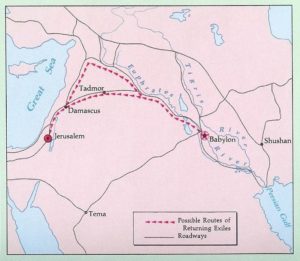
    The journey of the Israelites is quickly summed up in Ezra 2:1 by saying “They returned to Jerusalem…” but that was not as simple a journey as it sounds. That journey would have been close to 1,000 miles and would have taken several months. Here is a visual of the possible routes they may have taken to return to the Promised Land:


    Leave a Comment Below

    Did you learn something today? Share it with our Bible Reading Plan community by commenting below.

    Join the Team

    Interested in writing for the Bible Reading Plan? Email [email protected].

  • Ezra 1 + Introduction

    Ezra 1 + Introduction

    Ezra Introduction

    The books of Ezra and Nehemiah, much like 1 and 2 Samuel, originally started off as one long story that was eventually split up into two separate books. Ezra, which came first, covers a span of roughly 90 years, beginning in 538 B.C. following the original destruction of the first Jewish temple. After decades of exile in Babylon, it was time for God’s people, the Israelites, to return to Jerusalem and rebuild the temple. Enter Ezra and Nehemiah.

    These two books fall under the category of a historical book, similar to Joshua or 1 and 2 Samuel. Ezra and Nehemiah are interesting reads because they tell us different parts of a story that can, at times, appear somewhat unresolved. While you read, parts may even feel anticlimactic. So why are these two books important? These books give us a guide to revival within God’s people. It’s far too common to let apathy and the desire to go through the motions creep into our lives, our small groups, and our churches. Ezra and Nehemiah both call the people of God towards spiritual revitalization, and there is much we can learn from their stories.

    As we read, grab a journal and take good notes. What do these chapters teach you about God’s character? What does it teach you about humanity? What are the implications for you today? We have said it before, but it’s important to remember the significance of these Old Testament books. Too often we get confused by the Old Testament because some of the names sound funny and because we equate “old” with “irrelevant.” There are so many things we can learn about God and ourselves through the lens of this book. As we read the book of Ezra (and then Nehemiah), start each day with a prayer asking God to open your heart to what you need to learn today. Thanks for reading along with us! 

    Read Ezra 1

    Cyrus Helps the Exiles to Return

    In the first year of Cyrus king of Persia, in order to fulfill the word of the Lord spoken by Jeremiah, the Lord moved the heart of Cyrus king of Persia to make a proclamation throughout his realm and also to put it in writing:

    “This is what Cyrus king of Persia says:

    “‘The Lord, the God of heaven, has given me all the kingdoms of the earth and he has appointed me to build a temple for him at Jerusalem in Judah. Any of his people among you may go up to Jerusalem in Judah and build the temple of the Lord, the God of Israel, the God who is in Jerusalem, and may their God be with them. And in any locality where survivors may now be living, the people are to provide them with silver and gold, with goods and livestock, and with freewill offerings for the temple of God in Jerusalem.’”

    Then the family heads of Judah and Benjamin, and the priests and Levites—everyone whose heart God had moved—prepared to go up and build the house of the Lord in Jerusalem. All their neighbors assisted them with articles of silver and gold, with goods and livestock, and with valuable gifts, in addition to all the freewill offerings.

    Moreover, King Cyrus brought out the articles belonging to the temple of the Lord, which Nebuchadnezzar had carried away from Jerusalem and had placed in the temple of his god. Cyrus king of Persia had them brought by Mithredath the treasurer, who counted them out to Sheshbazzar the prince of Judah.

    This was the inventory:

    gold dishes30
    silver dishes1,000
    silver pans29
    10 gold bowls30
    matching silver bowls410
    other articles1,000

    11 In all, there were 5,400 articles of gold and of silver. Sheshbazzar brought all these along with the exiles when they came up from Babylon to Jerusalem.

    Go Deeper

    Ezra 1 introduces us to a notable person and a notable group of people. While this book is named after Ezra, we won’t actually meet him until chapter 7. The first person we’re introduced to is King Cyrus, the new Persian king in the first year of his reign. The Jews had lived in exile for decades, and finally, the new king was allowing them to return home. Not only did King Cyrus allow them to return to Jerusalem, he also gave them an important instruction—go rebuild the temple. 

    The notable group of people we meet next are the Israelites—God’s people. For some, this was an answered prayer! For others, the news was met with a shrug. Many were comfortable with their new lives in their new lands. The idea of going to Jerusalem to build a temple wasn’t appealing—they would rather just stay where they were. But for some, Scripture tells us that their hearts were moved (v. 5). Those who were ready to go back to Jerusalem were a minority, but they were a faithful minority. As we have seen time and time again throughout Scripture, you can never underestimate what God can do through a faithful group of people. They loaded up their belongings and made the trek back to Jerusalem to begin working on the task at hand. 

    So, what can we learn from these faithful few? They were obedient when God started moving in their hearts. Oftentimes we feel that same stirring—our hearts are moved—yet we don’t respond with full obedience because it requires us to give up something. While exiled, Israelites built homes and established livelihoods. To return to Jerusalem meant sacrificing comfort and their new normal, but God stirred their hearts and the faithful responded with obedience. As we go about our day today, pay attention to those nudges from God. He could nudge us to pray for a person whose name comes to mind, to call or text a friend, or he could move our hearts to respond to a need. It may not be as drastic as uprooting your family (although it could be), but obedience is God’s expectation every time. 

    Questions

    1. Why do you think so many of the Israelites in exile didn’t want to go back to Jerusalem?
    2. When was the last time God moved your heart? How did you respond? 
    3. What does this chapter teach you about God? What does it teach you about humanity?

    Did You Know?

    Curious why King Cyrus was so willing to send the Israelites home to Jerusalem? According to Josephus, the first century Jewish historian, Cyrus was familiar with the prophecies about him found in Isaiah 44 and 45. Whether or not he was a follower of Yahweh we can’t know for sure, but he had seen enough evidence of God to implore God’s people to rebuild the temple.

    Leave a Comment Below

    Did you learn something today? Share it with our Bible Reading Plan community by commenting below.

    Join the Team

    Interested in writing for the Bible Reading Plan? Email [email protected].

  • 2 Chronicles 36

    2 Chronicles 36

    Read 2 Chronicles 36

    Judah’s Decline

    36 The people of the land took Jehoahaz the son of Josiah and made him king in his father’s place in Jerusalem. Jehoahaz was twenty-three years old when he began to reign, and he reigned three months in Jerusalem.Then the king of Egypt deposed him in Jerusalem and laid on the land a tribute of a hundred talents of silver and a talent of gold. And the king of Egypt made Eliakim his brother king over Judah and Jerusalem, and changed his name to Jehoiakim. But Neco took Jehoahaz his brother and carried him to Egypt.

    Jehoiakim was twenty-five years old when he began to reign, and he reigned eleven years in Jerusalem. He did what was evil in the sight of the Lord his God. Against him came up Nebuchadnezzar king of Babylon and bound him in chains to take him to Babylon. Nebuchadnezzar also carried part of the vessels of the house of the Lord to Babylon and put them in his palace in Babylon. Now the rest of the acts of Jehoiakim, and the abominations that he did, and what was found against him, behold, they are written in the Book of the Kings of Israel and Judah. And Jehoiachin his son reigned in his place.

    Jehoiachin was eighteen years old when he became king, and he reigned three months and ten days in Jerusalem. He did what was evil in the sight of the Lord. 10 In the spring of the year King Nebuchadnezzar sent and brought him to Babylon, with the precious vessels of the house of the Lord, and made his brother Zedekiah king over Judah and Jerusalem.

    11 Zedekiah was twenty-one years old when he began to reign, and he reigned eleven years in Jerusalem. 12 He did what was evil in the sight of the Lord his God. He did not humble himself before Jeremiah the prophet, who spoke from the mouth of the Lord. 13 He also rebelled against King Nebuchadnezzar, who had made him swear by God. He stiffened his neck and hardened his heart against turning to the Lord, the God of Israel. 14 All the officers of the priests and the people likewise were exceedingly unfaithful, following all the abominations of the nations. And they polluted the house of the Lord that he had made holy in Jerusalem.

    15 The Lord, the God of their fathers, sent persistently to them by his messengers, because he had compassion on his people and on his dwelling place. 16 But they kept mocking the messengers of God, despising his words and scoffing at his prophets, until the wrath of the Lord rose against his people, until there was no remedy.

    Jerusalem Captured and Burned

    17 Therefore he brought up against them the king of the Chaldeans, who killed their young men with the sword in the house of their sanctuary and had no compassion on young man or virgin, old man or aged. He gave them all into his hand. 18 And all the vessels of the house of God, great and small, and the treasures of the house of the Lord, and the treasures of the king and of his princes, all these he brought to Babylon. 19 And they burned the house of God and broke down the wall of Jerusalem and burned all its palaces with fire and destroyed all its precious vessels. 20 He took into exile in Babylon those who had escaped from the sword, and they became servants to him and to his sons until the establishment of the kingdom of Persia, 21 to fulfill the word of the Lord by the mouth of Jeremiah, until the land had enjoyed its Sabbaths. All the days that it lay desolate it kept Sabbath, to fulfill seventy years.

    The Proclamation of Cyrus

    22 Now in the first year of Cyrus king of Persia, that the word of the Lord by the mouth of Jeremiah might be fulfilled, the Lord stirred up the spirit of Cyrus king of Persia, so that he made a proclamation throughout all his kingdom and also put it in writing: 23 “Thus says Cyrus king of Persia, ‘The Lord, the God of heaven, has given me all the kingdoms of the earth, and he has charged me to build him a house at Jerusalem, which is in Judah. Whoever is among you of all his people, may the Lord his God be with him. Let him go up.’”

    Go Deeper

    Throughout all of 2 Chronicles, and especially in today’s reading, we see a trend that still applies today: just because the world wants something, does not mean that it is actually good for us. We see a common theme of the preferences of the majority of people being placed over the will and desire of the Lord. This never ends well. Not in 2 Chronicles 36. Not in the Old Testament. Not in the New Testament. And not today.

    Reading this chapter feels a little…chaotic. One king appointed, another one carried off to a place, then another king carried off to another place, and so on and so forth. King after king, place after place, battle after battle, complete and utter chaos. Is chaos a characteristic of the Lord? First Corinthians 14:33 says that God is not a God of disorder, but of peace. Does this portion of history represented in this chapter of Scripture trend more towards disorder or peace? It is easy to read these texts and ask, “Why would they not see their mistakes and turn to the Lord? Clearly this was not working.” It is even easier to point the finger today and say, “Why doesn’t society today see their mistakes and turn to the Lord? Clearly this is not working.” However, God calls us to turn that finger around and point it at ourselves. 

    If your common thought pattern when reading Scripture is consistently, “I need to send this to ____,” or “These people in Scripture sure sound like ____,” then there might be a pride problem. If when listening to sermons you think, “I hope ____ is listening to this, they need to hear this,” you might have a pride problem. The common theme of people not knowing what they want does not just apply to “people,” it applies to all of us on an individual level. These texts are not historical reminders for the sake of knowing some fun Bible trivia. These texts are a reminder that we should not trust our own desires, our own plans, or our own opinions. 

    At the end of 2 Chronicles, we are issued a historical warning for what happens when we follow our own desires, plans, and opinions: Jerusalem falls. Death is everywhere. Not even the elderly and children are spared. This is where our ideas take us. God’s plan takes us to abundant life (John 10:10). Death or Life? This decision is not just for others who you deem more “lost.” It is a decision for you to make every day, every hour, and every moment. A decision that can only be made by relying on the strength of the Holy Spirit. Press into Him today. Let Him lead you to abundant life.

    Questions

    1. In what areas are you pursuing your own opinions rather than God’s truth?

    2. Do you tend to think Scripture and sermons that point out sin apply to others more than you? Why?

    3. Notice the age of the kings. They are all different, yet they all committed evil against a holy God. Why do you think it matters that we are shown ages besides just it being a historical fact? Remember Matthew 18:2-4.

    Watch This

    Now that we’re finished with 2 Chronicles, go back and watch this video from The Bible Project about all that transpired during 1 and 2 Chronicles.

    Leave a Comment below

    Did you learn something today? Share it with our Bible Reading Plan community by commenting below.

    Join the Team

    Interested in writing for the Bible Reading Plan? Email [email protected].

  • Rest Day + Family Guide (2 Chronicles 30-35)

    Rest Day + Family Guide (2 Chronicles 30-35)

    Rest Day

    Each Sunday is a Rest Day. There is no new Bible reading to do. Today, the goal is simple: rest in the presence of God. Maybe you need to use today to get caught up on the reading plan if you’re behind, maybe you want to journal what you’re learning so you don’t forget what God is teaching you, or maybe you want to spend time in concentrated prayer–do that. Above all, just spend time in God’s presence.

    Each Rest Day, we will have an additional element to help you dig deeper. Sometimes it will be extra resources to further your study, a video to watch, or a podcast to listen to. Sometimes we’ll have a verse to commit to memorize to help you hide God’s Word in your heart. 

    If you have kids, our Family Guide will help you discuss what you’re reading and learning with them! It’s a great opportunity for your family to read God’s Word together and review what we read the previous week!

    Keep Digging

    As we near the end of this journey through 1 & 2 Chronicles, look back through this guide from The Bible Project to see what all we have covered so far! 

    Family Guide

    Check out this week’s 2 Chronicles 30-35 Family Guide!