
Blog

  • Nehemiah 10

    Nehemiah 10

    Read Nehemiah 10

    Those who sealed it were:

    Nehemiah the governor, the son of Hakaliah.

    Zedekiah, Seraiah, Azariah, Jeremiah,

    Pashhur, Amariah, Malkijah,

    Hattush, Shebaniah, Malluk,

    Harim, Meremoth, Obadiah,

    Daniel, Ginnethon, Baruch,

    Meshullam, Abijah, Mijamin,

    Maaziah, Bilgai and Shemaiah.

    These were the priests.

    The Levites:

    Jeshua son of Azaniah, Binnui of the sons of Henadad, Kadmiel,

    10 and their associates: Shebaniah,

    Hodiah, Kelita, Pelaiah, Hanan,

    11 Mika, Rehob, Hashabiah,

    12 Zakkur, Sherebiah, Shebaniah,

    13 Hodiah, Bani and Beninu.

    14 The leaders of the people:

    Parosh, Pahath-Moab, Elam, Zattu, Bani,

    15 Bunni, Azgad, Bebai,

    16 Adonijah, Bigvai, Adin,

    17 Ater, Hezekiah, Azzur,

    18 Hodiah, Hashum, Bezai,

    19 Hariph, Anathoth, Nebai,

    20 Magpiash, Meshullam, Hezir,

    21 Meshezabel, Zadok, Jaddua,

    22 Pelatiah, Hanan, Anaiah,

    23 Hoshea, Hananiah, Hasshub,

    24 Hallohesh, Pilha, Shobek,

    25 Rehum, Hashabnah, Maaseiah,

    26 Ahiah, Hanan, Anan,

    27 Malluk, Harim and Baanah.

    28 “The rest of the people—priests, Levites, gatekeepers, musicians, temple servants and all who separated themselves from the neighboring peoples for the sake of the Law of God, together with their wives and all their sons and daughters who are able to understand— 29 all these now join their fellow Israelites the nobles, and bind themselves with a curse and an oath to follow the Law of God given through Moses the servant of God and to obey carefully all the commands, regulations and decrees of the Lord our Lord.

    30 “We promise not to give our daughters in marriage to the peoples around us or take their daughters for our sons.

    31 “When the neighboring peoples bring merchandise or grain to sell on the Sabbath, we will not buy from them on the Sabbath or on any holy day. Every seventh year we will forgo working the land and will cancel all debts.

    32 “We assume the responsibility for carrying out the commands to give a third of a shekel each year for the service of the house of our God: 33 for the bread set out on the table; for the regular grain offerings and burnt offerings; for the offerings on the Sabbaths, at the New Moon feasts and at the appointed festivals; for the holy offerings; for sin offerings to make atonement for Israel; and for all the duties of the house of our God.

    34 “We—the priests, the Levites and the people—have cast lots to determine when each of our families is to bring to the house of our God at set times each year a contribution of wood to burn on the altar of the Lord our God, as it is written in the Law.

    35 “We also assume responsibility for bringing to the house of the Lord each year the firstfruits of our crops and of every fruit tree.

    36 “As it is also written in the Law, we will bring the firstborn of our sons and of our cattle, of our herds and of our flocks to the house of our God, to the priests ministering there.

    37 “Moreover, we will bring to the storerooms of the house of our God, to the priests, the first of our ground meal, of our grain offerings, of the fruit of all our trees and of our new wine and olive oil. And we will bring a tithe of our crops to the Levites, for it is the Levites who collect the tithes in all the towns where we work. 38 A priest descended from Aaron is to accompany the Levites when they receive the tithes, and the Levites are to bring a tenth of the tithes up to the house of our God, to the storerooms of the treasury. 39 The people of Israel, including the Levites, are to bring their contributions of grain, new wine and olive oil to the storerooms, where the articles for the sanctuary and for the ministering priests, the gatekeepers and the musicians are also kept.

    “We will not neglect the house of our God.”

    Go Deeper

    Last we left off, the returned exiles had gathered around the word of God and worshipped God for His goodness. In view of this reading, they confessed their previous failures to keep the Law of Moses before God and one another; now, the exiles seal an agreement among the people to ensure that they never again rebel against God as they had before. The people of Israel are recommitting themselves to the Lord by laying out a covenant before Him. 

    This covenant has the potential to affect lasting behavioral change because it is specific in its commitment and personal in its accountability. The people specify what it is about their behavior they will change, generally falling under three categories: a commitment to covenant faithfulness in marriage, in business dealings, and in supporting the work of God. These three broader commitments are bound together in a final oath—“we will not neglect the house of our God.”   

    The people’s covenant agreement, however, is meaningless unless someone puts his name behind it—if no one commits to be held accountable for the actions of the people, then there will be no permanence to what they swear. There were 84 leaders of the remnant out of Babylon who committed to stand in the gap and be accountable for the actions of the people, before God and one another. This is an immense commitment, given that the people at this point likely number over 50,000 if the genealogy in Nehemiah is to be believed. These leaders echo the principle we find again in James 3:1—God holds those who lead to a high standard, and they will answer for those they shepherd.

    This text is a powerful picture of how to effectively turn from sin. First, Israel specifically identifies and confesses what they did wrong. Then, they specifically identify what they will do differently. Finally, they make clear how they will be held accountable to making lasting change. Joel 2:12-14 is clear that God’s heart for repentance is not that we would just make a show of knowing we sinned, but that we would offer him our hearts once more in obedience and in affection—exactly what the exiles do here.  

    Questions

    1. What did this chapter teach you about God? What did it teach you about humanity?
    2. Try to make your own repentance covenant:
      1. What sin do you need to repent of? 
      2. What about your disobedience needs to particularly change?
      3. Who is going to hold you accountable, and how?
    3. Who can you stand in the gap for and hold accountable to repentance in your community? How might you help them commit to a faithful covenant relationship with Jesus?

    Listen Here

    Hear a reflection from the author of today’s devotional.

    Leave a Comment Below

    Did you learn something today? Share it with our Bible Reading Plan community by commenting below.

    Join the Team

    Interested in writing for the Bible Reading Plan? Email [email protected].
  • Nehemiah 9

    Nehemiah 9

    Read Nehemiah 9

    The Israelites Confess Their Sins

    On the twenty-fourth day of the same month, the Israelites gathered together, fasting and wearing sackcloth and putting dust on their heads. Those of Israelite descent had separated themselves from all foreigners. They stood in their places and confessed their sins and the sins of their ancestors. They stood where they were and read from the Book of the Law of the Lord their God for a quarter of the day, and spent another quarter in confession and in worshiping the Lord their God. Standing on the stairs of the Levites were Jeshua, Bani, Kadmiel, Shebaniah, Bunni, Sherebiah, Bani and Kenani. They cried out with loud voices to the Lord their God. And the Levites—Jeshua, Kadmiel, Bani, Hashabneiah, Sherebiah, Hodiah, Shebaniah and Pethahiah—said: “Stand up and praise the Lord your God, who is from everlasting to everlasting.”

    “Blessed be your glorious name, and may it be exalted above all blessing and praise. You alone are the Lord. You made the heavens, even the highest heavens, and all their starry host, the earth and all that is on it, the seas and all that is in them. You give life to everything, and the multitudes of heaven worship you.

    “You are the Lord God, who chose Abram and brought him out of Ur of the Chaldeans and named him Abraham. You found his heart faithful to you, and you made a covenant with him to give to his descendants the land of the Canaanites, Hittites, Amorites, Perizzites, Jebusites and Girgashites. You have kept your promise because you are righteous.

    “You saw the suffering of our ancestors in Egypt; you heard their cry at the Red Sea. 10 You sent signs and wonders against Pharaoh, against all his officials and all the people of his land, for you knew how arrogantly the Egyptians treated them. You made a name for yourself, which remains to this day. 11 You divided the sea before them, so that they passed through it on dry ground, but you hurled their pursuers into the depths, like a stone into mighty waters. 12 By day you led them with a pillar of cloud, and by night with a pillar of fire to give them light on the way they were to take.

    13 “You came down on Mount Sinai; you spoke to them from heaven. You gave them regulations and laws that are just and right, and decrees and commands that are good. 14 You made known to them your holy Sabbath and gave them commands, decrees and laws through your servant Moses. 15 In their hunger you gave them bread from heaven and in their thirst you brought them water from the rock; you told them to go in and take possession of the land you had sworn with uplifted hand to give them.

    16 “But they, our ancestors, became arrogant and stiff-necked, and they did not obey your commands. 17 They refused to listen and failed to remember the miracles you performed among them. They became stiff-necked and in their rebellion appointed a leader in order to return to their slavery. But you are a forgiving God, gracious and compassionate, slow to anger and abounding in love. Therefore you did not desert them, 18 even when they cast for themselves an image of a calf and said, ‘This is your god, who brought you up out of Egypt,’ or when they committed awful blasphemies.

    19 “Because of your great compassion you did not abandon them in the wilderness. By day the pillar of cloud did not fail to guide them on their path, nor the pillar of fire by night to shine on the way they were to take. 20 You gave your good Spirit to instruct them. You did not withhold your manna from their mouths, and you gave them water for their thirst. 21 For forty years you sustained them in the wilderness; they lacked nothing, their clothes did not wear out nor did their feet become swollen.

    22 “You gave them kingdoms and nations, allotting to them even the remotest frontiers. They took over the country of Sihon king of Heshbon and the country of Og king of Bashan. 23 You made their children as numerous as the stars in the sky, and you brought them into the land that you told their parents to enter and possess. 24 Their children went in and took possession of the land. You subdued before them the Canaanites, who lived in the land; you gave the Canaanites into their hands, along with their kings and the peoples of the land, to deal with them as they pleased. 25 They captured fortified cities and fertile land; they took possession of houses filled with all kinds of good things, wells already dug, vineyards, olive groves and fruit trees in abundance. They ate to the full and were well-nourished; they reveled in your great goodness.

    26 “But they were disobedient and rebelled against you; they turned their backs on your law. They killed your prophets, who had warned them in order to turn them back to you; they committed awful blasphemies. 27 So you delivered them into the hands of their enemies, who oppressed them. But when they were oppressed they cried out to you. From heaven you heard them, and in your great compassion you gave them deliverers, who rescued them from the hand of their enemies.

    28 “But as soon as they were at rest, they again did what was evil in your sight. Then you abandoned them to the hand of their enemies so that they ruled over them. And when they cried out to you again, you heard from heaven, and in your compassion you delivered them time after time.

    29 “You warned them in order to turn them back to your law, but they became arrogant and disobeyed your commands. They sinned against your ordinances, of which you said, ‘The person who obeys them will live by them.’ Stubbornly they turned their backs on you, became stiff-necked and refused to listen. 30 For many years you were patient with them. By your Spirit you warned them through your prophets. Yet they paid no attention, so you gave them into the hands of the neighboring peoples. 31 But in your great mercy you did not put an end to them or abandon them, for you are a gracious and merciful God.

    32 “Now therefore, our God, the great God, mighty and awesome, who keeps his covenant of love, do not let all this hardship seem trifling in your eyes—the hardship that has come on us, on our kings and leaders, on our priests and prophets, on our ancestors and all your people, from the days of the kings of Assyria until today. 33 In all that has happened to us, you have remained righteous; you have acted faithfully, while we acted wickedly. 34 Our kings, our leaders, our priests and our ancestors did not follow your law; they did not pay attention to your commands or the statutes you warned them to keep. 35 Even while they were in their kingdom, enjoying your great goodness to them in the spacious and fertile land you gave them, they did not serve you or turn from their evil ways.

    36 “But see, we are slaves today, slaves in the land you gave our ancestors so they could eat its fruit and the other good things it produces. 37 Because of our sins, its abundant harvest goes to the kings you have placed over us. They rule over our bodies and our cattle as they please. We are in great distress.

    The Agreement of the People

    38 “In view of all this, we are making a binding agreement, putting it in writing, and our leaders, our Levites and our priests are affixing their seals to it.”

    Go Deeper

    Nehemiah 9 covers the national confession of sin. The Israelites had recently completed work on the wall—what a victory! Yet, the Israelites took on a posture of humility, and they spent six hours reading from the book of the law and six hours in confession and worship. That’s twelve consecutive hours of being with the Father!

    The verses that follow communicate not only how Israel sinned, but also who God is and what He did for the Israelites. The author writes the word “you” over thirty times when speaking of God initiating or accomplishing something. Throughout the 37 verses of the chapter, the author attributes these action words to God:

    • gave
    • multiplied
    • handed
    • warned
    • heard
    • told
    • provided
    • created
    • found 
    • delivered
    • …and many more 

    These verses remind us of the initiator and sustainer that God is. The promises of God depend on God. God held the Israelites together and carried out His plan for their lives though they lived in rebellion. We can expect the same from God in our own lives. God holds the world together; we do not. God keeps our relationship with Him intact, and we get to respond to that assurance daily.

    The word “but” appears in this chapter a few times. Right before each “but,” the passage describes God’s overwhelming kindness and generosity to the Israelites.

    •  Verse 25: “They ate to the full and were well-nourished; they reveled in your great goodness.
    • Verse 27: “In your great compassion you gave them deliverers, who rescued them from the hand of their enemies
    • Verse 29: “You warned them in order to turn them back to your law

    God did not have to show abundant compassion or even warn the Israelites, yet He did. We see God’s gentleness toward people who keep missing the mark. After these same three examples, following the “but,” we see the rebellion of the Israelites.

    •  Verse 26: “But they were disobedient and rebelled against you; they turned their backs on your law.”
    • Verse 28: “But as soon as they were at rest, they again did what was evil in your sight.
    • Verse 29: “But they became arrogant and disobeyed your commands.

    When the Israelites rebelled, they weren’t trying to get on God’s good side. Yet, their bad behavior didn’t change God’s character. God is kind, and He wasn’t just kind to them once. His kindness won’t run out on us either. He keeps His promises regardless of our actions. Though the Israelites suffered consequences from sin, God continued to deliver them and extend compassion to them. He is truly a “gracious and merciful God” who “keeps his covenant of love” (v. 31-32). Be reminded that God’s love for us is so much greater than ours could ever be for Him.     


    Questions

    1. How have you seen God’s kindness to you despite your failures?
    2. Have you spent time in confession and prayer about the ways you’ve missed the mark?
    3. What is one way this week you can act in humility?

    A Quote

    “The great basis of the Christian assurance is not how much our hearts are set on God, but how unshakably his heart is set on us.”—Tim Keller

    Leave a Comment Below

    Did you learn something today? Share it with our Bible Reading Plan community by commenting below.

    Join the Team

    Interested in writing for the Bible Reading Plan? Email [email protected].

  • Rest Day 1

    Rest Day 1

    Rest Day

    Today is a Rest Day. There is no new Bible reading to do. Today, the goal is simple: rest in the presence of God. Maybe you need to use today to get caught up on the reading plan if you’re behind, maybe you want to journal what you’re learning so you don’t forget what God is teaching you, or maybe you want to spend time in concentrated prayer–do that. Above all, just spend time in God’s presence. Each Rest Day, we will also introduce a memory verse for the week. Meditate on this week’s verse and begin to memorize it.

    Memory Verse

    Nehemiah said, “Go and enjoy choice food and sweet drinks, and send some to those who have nothing prepared. This day is holy to our Lord. Do not grieve, for the joy of the Lord is your strength.”

    Nehemiah 8:10

    Memorization Tip

    Use community as a tool to help you in your Scripture memorization journey! Pick a few friends, or your Life Group, with whom to memorize Scripture. Practice together, hold each other accountable, and encourage one another as you work together. Remember that the best way to stick with a challenge is to not go at it alone!

    Worship with Us

    Join us at 9a, 11a, or 7p in person or online at harriscreek.org/live. We’d love to worship with you! We also desire to connect everyone with a local church body where they can thrive in community and use their gifts to serve. If you’re following our Bible Reading Plan from outside of Waco and are eager to get connected with a great local church, email us at [email protected].

    Leave a Comment Below
    Did you learn something today? Share it with our Bible Reading Plan community by commenting below.
  • Nehemiah 8

    Nehemiah 8

    Read Nehemiah 8

    all the people came together as one in the square before the Water Gate. They told Ezra the teacher of the Law to bring out the Book of the Law of Moses, which the Lord had commanded for Israel.

    So on the first day of the seventh month Ezra the priest brought the Law before the assembly, which was made up of men and women and all who were able to understand. He read it aloud from daybreak till noon as he faced the square before the Water Gate in the presence of the men, women and others who could understand. And all the people listened attentively to the Book of the Law.

    Ezra the teacher of the Law stood on a high wooden platform built for the occasion. Beside him on his right stood Mattithiah, Shema, Anaiah, Uriah, Hilkiah and Maaseiah; and on his left were Pedaiah, Mishael, Malkijah, Hashum, Hashbaddanah, Zechariah and Meshullam.

    Ezra opened the book. All the people could see him because he was standing above them; and as he opened it, the people all stood up. Ezra praised the Lord, the great God; and all the people lifted their hands and responded, “Amen! Amen!” Then they bowed down and worshiped the Lord with their faces to the ground.

    The Levites—Jeshua, Bani, Sherebiah, Jamin, Akkub, Shabbethai, Hodiah, Maaseiah, Kelita, Azariah, Jozabad, Hanan and Pelaiah—instructed the people in the Law while the people were standing there. They read from the Book of the Law of God, making it clear and giving the meaning so that the people understood what was being read.

    Then Nehemiah the governor, Ezra the priest and teacher of the Law, and the Levites who were instructing the people said to them all, “This day is holy to the Lord your God. Do not mourn or weep.” For all the people had been weeping as they listened to the words of the Law.

    10 Nehemiah said, “Go and enjoy choice food and sweet drinks, and send some to those who have nothing prepared. This day is holy to our Lord. Do not grieve, for the joy of the Lord is your strength.”

    11 The Levites calmed all the people, saying, “Be still, for this is a holy day. Do not grieve.”

    12 Then all the people went away to eat and drink, to send portions of food and to celebrate with great joy, because they now understood the words that had been made known to them.

    13 On the second day of the month, the heads of all the families, along with the priests and the Levites, gathered around Ezra the teacher to give attention to the words of the Law. 14 They found written in the Law, which the Lord had commanded through Moses, that the Israelites were to live in temporary shelters during the festival of the seventh month 15 and that they should proclaim this word and spread it throughout their towns and in Jerusalem: “Go out into the hill country and bring back branches from olive and wild olive trees, and from myrtles, palms and shade trees, to make temporary shelters”—as it is written.

    16 So the people went out and brought back branches and built themselves temporary shelters on their own roofs, in their courtyards, in the courts of the house of God and in the square by the Water Gate and the one by the Gate of Ephraim. 17 The whole company that had returned from exile built temporary shelters and lived in them. From the days of Joshua son of Nun until that day, the Israelites had not celebrated it like this. And their joy was very great.

    18 Day after day, from the first day to the last, Ezra read from the Book of the Law of God. They celebrated the festival for seven days, and on the eighth day, in accordance with the regulation, there was an assembly.

    Go Deeper

    In this day and age, many Christians long to see revival take place. We look at the world around us and see evident injustice and brokenness everywhere we look. We live in a war of ideas, ideologies, and opinions. In every headline, in every news source, and all over social media, we see evidence of the way sin wreaks havoc on humanity. Seeing the devastation of sin increases the Church’s longing to see revival and spiritual awakening in America and all around the world.

    J. Edwin Orr defines revival as the “Spirit of God working through the Word of God, in the lives of the people of God.” This type of revival is exactly what happens in Nehemiah 8. Right away in verse 1, the people gather together in unity and tell Ezra to bring the Book of the Law. This is wild because apart from the working of the Holy Spirit, people don’t just naturally gather together to hear the Word of God read aloud for six hours. The Spirit of God was already wooing the people to Himself and doing a work in their heart far before Ezra began to read God’s Word. 

    When Ezra reads aloud the Word of God in the presence of the Israelites, it leads them to deep, reverent worship and obedience to the one true God of Israel. Following the hearing of the Word of God, God’s people repent. They fall on their faces to worship God. They weep as they are convicted of their sin and reminded of their continued unfaithfulness to God. In the midst of this conviction, Nehemiah reminds the people of the strength and joy to be found in the Lord. Though they have sinned greatly against a holy God, He is greater. He brings the dead to life. He redeems the unfaithful. He turns weeping into celebration. It’s who He is. 

    The same is true for us today. Though the world is dark and without the hope of Jesus, we can experience revival and spiritual awakening as a result of the Spirit of God working mightily through the Word of God.

    If you want to see revival in your own life and the world, pray for God’s Spirit to awaken you to the deep truths of His Word. Just as Ezra and Nehemiah obeyed God, consider how the Lord might use your obedience as a means to lead others into undivided worship and joyful devotion to God.

    Questions

    1. What inspires you the most about this chapter?
    2. Does the reading of God’s Word lead you to revere Him and turn from your sin?
    3. In what area of your life do you need to believe the truth that “the joy of the Lord is your strength” (v. 10)? The Lord is inviting you to rest in that promise.

    A Quote

    “When Satan huffs and puffs and tries to blow out the flame of your joy, you have an endless supply of kindling in the Word of God.” -John Piper

    Leave a Comment Below

    Did you learn something today? Share it with our Bible Reading Plan community by commenting below.

    Join the Team

    Interested in writing for the Bible Reading Plan? Email [email protected].

  • Nehemiah 7

    Nehemiah 7

    Read Nehemiah 7

    After the wall had been rebuilt and I had set the doors in place, the gatekeepers, the musicians and the Levites were appointed. I put in charge of Jerusalem my brother Hanani, along with Hananiah the commander of the citadel, because he was a man of integrity and feared God more than most people do. I said to them, “The gates of Jerusalem are not to be opened until the sun is hot. While the gatekeepers are still on duty, have them shut the doors and bar them. Also appoint residents of Jerusalem as guards, some at their posts and some near their own houses.”

    The List of the Exiles Who Returned

    Now the city was large and spacious, but there were few people in it, and the houses had not yet been rebuilt. So my God put it into my heart to assemble the nobles, the officials and the common people for registration by families. I found the genealogical record of those who had been the first to return. This is what I found written there:

    These are the people of the province who came up from the captivity of the exiles whom Nebuchadnezzar king of Babylon had taken captive (they returned to Jerusalem and Judah, each to his own town, in company with Zerubbabel, Joshua, Nehemiah, Azariah, Raamiah, Nahamani, Mordecai, Bilshan, Mispereth, Bigvai, Nehum and Baanah):

    The list of the men of Israel:

    the descendants of Parosh2,172
    of Shephatiah372
    10 of Arah652
    11 of Pahath-Moab (through the line of Jeshua and Joab)2,818
    12 of Elam1,254
    13 of Zattu845
    14 of Zakkai760
    15 of Binnui648
    16 of Bebai628
    17 of Azgad2,322
    18 of Adonikam667
    19 of Bigvai2,067
    20 of Adin655
    21 of Ater (through Hezekiah)98
    22 of Hashum328
    23 of Bezai324
    24 of Hariph112
    25 of Gibeon95
    26 the men of Bethlehem and Netophah188
    27 of Anathoth128
    28 of Beth Azmaveth42
    29 of Kiriath Jearim, Kephirah and Beeroth743
    30 of Ramah and Geba621
    31 of Mikmash122
    32 of Bethel and Ai123
    33 of the other Nebo52
    34 of the other Elam1,254
    35 of Harim320
    36 of Jericho345
    37 of Lod, Hadid and Ono721
    38 of Senaah3,930

    39 The priests:

    the descendants of Jedaiah (through the family of Jeshua)973
    40 of Immer1,052
    41 of Pashhur1,247
    42 of Harim1,017

    43 The Levites:

    the descendants of Jeshua (through Kadmiel through the line of Hodaviah)74

    44 The musicians:

    the descendants of Asaph148

    45 The gatekeepers:

    the descendants of
    Shallum, Ater, Talmon, Akkub, Hatita and Shobai138

    46 The temple servants:

    the descendants of
    Ziha, Hasupha, Tabbaoth,
    47 Keros, Sia, Padon,
    48 Lebana, Hagaba, Shalmai,
    49 Hanan, Giddel, Gahar,
    50 Reaiah, Rezin, Nekoda,
    51 Gazzam, Uzza, Paseah,
    52 Besai, Meunim, Nephusim,
    53 Bakbuk, Hakupha, Harhur,
    54 Bazluth, Mehida, Harsha,
    55 Barkos, Sisera, Temah,
    56 Neziah and Hatipha

    57 The descendants of the servants of Solomon:

    the descendants of
    Sotai, Sophereth, Perida,
    58 Jaala, Darkon, Giddel,
    59 Shephatiah, Hattil,
    Pokereth-Hazzebaim and Amon
    60 The temple servants and the descendants of the servants of Solomon392

    61 The following came up from the towns of Tel Melah, Tel Harsha, Kerub, Addon and Immer, but they could not show that their families were descended from Israel:

    62 the descendants of
    Delaiah, Tobiah and Nekoda642

    63 And from among the priests:

    the descendants of
    Hobaiah, Hakkoz and Barzillai (a man who had married a daughter of Barzillai the Gileadite and was called by that name).

    64 These searched for their family records, but they could not find them and so were excluded from the priesthood as unclean. 65 The governor, therefore, ordered them not to eat any of the most sacred food until there should be a priest ministering with the Urim and Thummim.

    66 The whole company numbered 42,360, 67 besides their 7,337 male and female slaves; and they also had 245 male and female singers. 68 There were 736 horses, 245 mules, 69 435 camels and 6,720 donkeys.

    70 Some of the heads of the families contributed to the work. The governor gave to the treasury 1,000 darics of gold, 50 bowls and 530 garments for priests. 71 Some of the heads of the families gave to the treasury for the work 20,000 darics of gold and 2,200 minas of silver. 72 The total given by the rest of the people was 20,000 darics of gold, 2,000 minaseof silver and 67 garments for priests.

    73 The priests, the Levites, the gatekeepers, the musicians and the temple servants, along with certain of the people and the rest of the Israelites, settled in their own towns.

    Ezra Reads the Law

    When the seventh month came and the Israelites had settled in their towns,

    Go Deeper

    Nehemiah was given a remarkable amount of authority and influence in his role as governor of Judah. As we have seen in previous chapters, as vital as this task was, it faced opposition every step of the way. In this chapter, Nehemiah is divinely prompted to summon the people for enrollment. This prompting and re-enrollment was the precursor for the life changes and re-dedication that occurs in the next few chapters of this book. Nehemiah wanted people to remember Whose they were, how far God had brought them, and what God had called them to do before they moved forward.

    Nehemiah was faithful to see the project through to completion. He kept his team focused through leadership centered around the Word of the Lord and the calling God had placed on their lives. The wall was finished; the project completed. However, Nehemiah remembered that the final strength or weakness of a city is its people. Because of this, he put two individuals, Hanani and Hananiah, who had been faithful previously, and who had consistently shown their love for the Lord, in charge of the city while they continued to rebuild and while Nehemiah tended to other duties. This word “faithful” is where we should focus our minds as we read today.

    Luke 16:10 says “One who is faithful in a very little is also faithful in much, and one who is dishonest in a very little is also dishonest in much.” Nehemiah, Hanani, and Hananiah were faithful to complete the tasks placed before them by the Lord and care for God’s people. Due to this faithfulness, they were given positions of authority to play a larger part in God’s plan for Jerusalem and His people.

    Imagine how many frustrating, time-consuming, and downright annoying tasks these three individuals had to face in exile and while rebuilding the wall. Many would have tapped-out and called it a day or openly complained about their situation. Instead, these individuals were faithful to complete God’s calling on their lives to the best of their ability and steward the lives of those who had been entrusted into their care.

    God is calling you to be faithful and excellent in the stage of life He has currently placed you, like Nehemiah, Hanani, and Hananiah. It may not seem like it, but God has you where you are for a specific reason. It may seem like you are just “building a wall” (answering emails, grading papers, taking care of your children), but your faithfulness now will pay massive dividends in the Kingdom of God for all of eternity. Steward well. Trust God. Strive for faithfulness.

    Questions

    1. How can you be a better steward of the opportunities and leadership God has given you?
    2. What tasks has God given you that you could do more excellently and faithfully?
    3. Who are individuals in your life that can be your Hanani and Hananiah that you can link arms with and pursue God’s calling together?

    Try This

    Just as Nehemiah felt prompted by God to call everyone together to remember whose they were, how far God had brought them, and what God had called them to do, it is important that we do the same. Take some time now to reflect on who God says you are, where you used to be, how far God has brought you, where you believe God is taking you, and how you can faithfully fulfill God’s calling on your life today.

    Leave a Comment Below

    Did you learn something today? Share it with our Bible Reading Plan community by commenting below.

    Join the Team

    Interested in writing for the Bible Reading Plan? Email [email protected].

  • Nehemiah 6

    Nehemiah 6

    Read Nehemiah 6

    Further Opposition to the Rebuilding

    When word came to Sanballat, Tobiah, Geshem the Arab and the rest of our enemies that I had rebuilt the wall and not a gap was left in it—though up to that time I had not set the doors in the gates— Sanballat and Geshem sent me this message: “Come, let us meet together in one of the villages on the plain of Ono.”

    But they were scheming to harm me; so I sent messengers to them with this reply: “I am carrying on a great project and cannot go down. Why should the work stop while I leave it and go down to you?” Four times they sent me the same message, and each time I gave them the same answer.

    Then, the fifth time, Sanballat sent his aide to me with the same message, and in his hand was an unsealed letter in which was written:

    “It is reported among the nations—and Geshem says it is true—that you and the Jews are plotting to revolt, and therefore you are building the wall. Moreover, according to these reports you are about to become their king and have even appointed prophets to make this proclamation about you in Jerusalem: ‘There is a king in Judah!’ Now this report will get back to the king; so come, let us meet together.”

    I sent him this reply: “Nothing like what you are saying is happening; you are just making it up out of your head.”

    They were all trying to frighten us, thinking, “Their hands will get too weak for the work, and it will not be completed.”

    But I prayed, “Now strengthen my hands.”

    10 One day I went to the house of Shemaiah son of Delaiah, the son of Mehetabel, who was shut in at his home. He said, “Let us meet in the house of God, inside the temple, and let us close the temple doors, because men are coming to kill you—by night they are coming to kill you.”

    11 But I said, “Should a man like me run away? Or should someone like me go into the temple to save his life? I will not go!” 12 I realized that God had not sent him, but that he had prophesied against me because Tobiah and Sanballat had hired him. 13 He had been hired to intimidate me so that I would commit a sin by doing this, and then they would give me a bad name to discredit me.

    14 Remember Tobiah and Sanballat, my God, because of what they have done; remember also the prophet Noadiah and how she and the rest of the prophets have been trying to intimidate me. 15 So the wall was completed on the twenty-fifth of Elul, in fifty-two days.

    Opposition to the Completed Wall

    16 When all our enemies heard about this, all the surrounding nations were afraid and lost their self-confidence, because they realized that this work had been done with the help of our God.

    17 Also, in those days the nobles of Judah were sending many letters to Tobiah, and replies from Tobiah kept coming to them. 18 For many in Judah were under oath to him, since he was son-in-law to Shekaniah son of Arah, and his son Jehohanan had married the daughter of Meshullam son of Berekiah. 19 Moreover, they kept reporting to me his good deeds and then telling him what I said. And Tobiah sent letters to intimidate me.

    Go Deeper

    “So the wall was finished.” 

    These simple words in verse fifteen are a declaration of sustained obedience to the calling of God in our lives. Sustained obedience will always triumph over pressure and fear. Sustained obedience requires us to discern which projects and people are distractions and which are part of his plan for our lives.

    As Nehemiah nears completion of the wall, the pressure mounts. Threats are made on his life. His enemies do all they can to distract and delay him from working on the wall. They come up with a variety of schemes to humiliate him, run him out of town, and, if given the chance, murder him. Anything and everything is on the table to stop Nehemiah’s work on the wall.

    Fear is at the center of this passage. And fear is often at the center of our own choice to be obedient. Sanballat, Tobiah, and Geshem try to leverage fear as a weapon against Nehemiah. The irony is they are the ones who are afraid, not Nehemiah. Their minds are overcome with fear that he will finish the wall. Out of fear, they turn to evil. On the other hand, Nehemiah maintains composure. Like the wall he has been building, he is not easily shaken. Evidence is provided by his response in verse 3. After they have tried to lure him into a trap, Nehemiah asks, “Why should the work stop?”

    Why was it right to disregard the people as distractions and focus on the project in Nehemiah 6, but wrong in Nehemiah 5? God is teaching us to exercise discernment. Circumstances change. Decisions are not always made the same way every time because the circumstances are rarely the same every time. In chapter 6, Nehemiah realizes the people coming to him are distractions and should not be given attention over the project of finishing the wall. There are times when we should be focused on a singular task. Complete the work. 

    So the wall was finished.

    Whatever God has placed before us in this season, let us work in obedience until we can declare the same.

    Questions

    1. What are all the different ways that Sanballat, Tobiah, and Geshem try to stop Nehemiah in this chapter? How does Nehemiah respond?
    2. How do the surrounding nations react to news of the wall’s completion?
    3. What scares you most about being obedient to the work God has called you to do?

    Pray This

    Father, reading this story reminds us of the parallels of Jesus and the cross. Jesus was also called to a great work and mocked, scorned and threatened. He, too, moved forward with a singular purpose because the work before him had to be done. So let us follow the example of Jesus. Give us courage to do the work you place before us. Help us remain faithful to You, as You have remained faithful to us. Amen.

    Leave a Comment Below

    Did you learn something today? Share it with our Bible Reading Plan community by commenting below.

    Join the Team

    Interested in writing for the Bible Reading Plan? Email [email protected].

  • Nehemiah 5

    Nehemiah 5

    Read Nehemiah 5

    Nehemiah Helps the Poor

    Now the men and their wives raised a great outcry against their fellow Jews. Some were saying, “We and our sons and daughters are numerous; in order for us to eat and stay alive, we must get grain.”

    Others were saying, “We are mortgaging our fields, our vineyards and our homes to get grain during the famine.”

    Still others were saying, “We have had to borrow money to pay the king’s tax on our fields and vineyards. Although we are of the same flesh and blood as our fellow Jews and though our children are as good as theirs, yet we have to subject our sons and daughters to slavery. Some of our daughters have already been enslaved, but we are powerless, because our fields and our vineyards belong to others.”

    When I heard their outcry and these charges, I was very angry. I pondered them in my mind and then accused the nobles and officials. I told them, “You are charging your own people interest!” So I called together a large meeting to deal with them and said: “As far as possible, we have bought back our fellow Jews who were sold to the Gentiles. Now you are selling your own people, only for them to be sold back to us!” They kept quiet, because they could find nothing to say.

    So I continued, “What you are doing is not right. Shouldn’t you walk in the fear of our God to avoid the reproach of our Gentile enemies? 10 I and my brothers and my men are also lending the people money and grain. But let us stop charging interest! 11 Give back to them immediately their fields, vineyards, olive groves and houses, and also the interest you are charging them—one percent of the money, grain, new wine and olive oil.”

    12 “We will give it back,” they said. “And we will not demand anything more from them. We will do as you say.”

    Then I summoned the priests and made the nobles and officials take an oath to do what they had promised. 13 I also shook out the folds of my robe and said, “In this way may God shake out of their house and possessions anyone who does not keep this promise. So may such a person be shaken out and emptied!”

    At this the whole assembly said, “Amen,” and praised the Lord. And the people did as they had promised.

    14 Moreover, from the twentieth year of King Artaxerxes, when I was appointed to be their governor in the land of Judah, until his thirty-second year—twelve years—neither I nor my brothers ate the food allotted to the governor. 15 But the earlier governors—those preceding me—placed a heavy burden on the people and took forty shekels of silver from them in addition to food and wine. Their assistants also lorded it over the people. But out of reverence for God I did not act like that. 16 Instead, I devoted myself to the work on this wall. All my men were assembled there for the work; we did not acquire any land.

    17 Furthermore, a hundred and fifty Jews and officials ate at my table, as well as those who came to us from the surrounding nations. 18 Each day one ox, six choice sheep and some poultry were prepared for me, and every ten days an abundant supply of wine of all kinds. In spite of all this, I never demanded the food allotted to the governor, because the demands were heavy on these people.

    19 Remember me with favor, my God, for all I have done for these people.

    Go Deeper

    In chapter 5, we find Nehemiah focused on the goal of rebuilding the wall around Jerusalem. But why was this so important in the first place? The wall placed a boundary around Jerusalem. It protected it and kept it safe. With God’s help, Nehemiah has convinced Jewish officials and city residents to rebuild together. While engrossed in the project, some of his fellow Jews claimed to be mistreated. Nehemiah certainly could have told them he was extremely busy and to come back once the wall was finished. He didn’t. Nehemiah did not hesitate. He stopped working to listen. Nehemiah put others’ interests above his own and paused his work on the wall.

    Nehemiah learned Jews were being taken advantage of by outsiders and other Jews. Poor Jewish families were being forced to borrow money to buy food during the famine and pay the king’s taxes. Jewish lenders, often nobles and officials, were taking advantage of them by charging high interest rates and demanding property in exchange for debt owed. Jews were even enslaving the children of parents who could not pay back debts. 

    With the wall project still waiting, Nehemiah called a meeting to address the issues among the Jews. Nehemiah confronted and then encouraged the Jewish people to walk in fear of the Lord and do what was right. Confiscated fields, vineyards, olive groves and houses exchanged for debt should be returned. God stirred their hearts. All agreed to return what belonged to their neighbors and end the exorbitant interest rates and demands. 

    What lessons can we learn? Some lessons are simple. Love our neighbors as ourselves (see also Mark 12:31; Gal 5:14). Take care of the poor (see also Prov 19:17). The main lesson is more complex. Through Nehemiah’s story, God illustrates how we should be concerned about the project and the people. The project may be good. Nehemiah’s project was good and worthwhile. But good projects can (and sometimes should) be paused to help people. He calls us to be aware of and not ignore those around us, bearing the burden of others (Gal 6:2). 

    Nehemiah helped with the issues and concerns of the poor and then returned to the wall to devote himself to completing the repairs. Nehemiah prioritized God’s work and was very generous to God’s people over the years that followed. He continued to look out for the needs of his people, outwardly focused and God-honoring.  

    Questions

    1. What project are you focused on at the expense of people? 
    2. What action(s) can you take today to ensure that you do not solely focus on your own interests but also the interests of others (Phil 2:4)?
    3. Who can you lovingly encourage to help others?

    A Quote

    “Nehemiah was not a politician who asked, ‘What is popular?’ or a diplomat who asked, ‘What is safe?’ but a true leader who asked, ‘What is right?’”–Warren Wiersbe 

    Leave a Comment Below

    Did you learn something today? Share it with our Bible Reading Plan community by commenting below.

    Join the Team

    Interested in writing for the Bible Reading Plan? Email [email protected].

  • Nehemiah 4

    Nehemiah 4

    Read Nehemiah 4

    Opposition to the Rebuilding

    When Sanballat heard that we were rebuilding the wall, he became angry and was greatly incensed. He ridiculed the Jews, and in the presence of his associates and the army of Samaria, he said, “What are those feeble Jews doing? Will they restore their wall? Will they offer sacrifices? Will they finish in a day? Can they bring the stones back to life from those heaps of rubble—burned as they are?”

    Tobiah the Ammonite, who was at his side, said, “What they are building—even a fox climbing up on it would break down their wall of stones!”

    Hear us, our God, for we are despised. Turn their insults back on their own heads. Give them over as plunder in a land of captivity. Do not cover up their guilt or blot out their sins from your sight, for they have thrown insults in the face of the builders.

    So we rebuilt the wall till all of it reached half its height, for the people worked with all their heart.

    But when Sanballat, Tobiah, the Arabs, the Ammonites and the people of Ashdod heard that the repairs to Jerusalem’s walls had gone ahead and that the gaps were being closed, they were very angry. They all plotted together to come and fight against Jerusalem and stir up trouble against it. But we prayed to our God and posted a guard day and night to meet this threat.

    10 Meanwhile, the people in Judah said, “The strength of the laborers is giving out, and there is so much rubble that we cannot rebuild the wall.”

    11 Also our enemies said, “Before they know it or see us, we will be right there among them and will kill them and put an end to the work.”

    12 Then the Jews who lived near them came and told us ten times over, “Wherever you turn, they will attack us.”

    13 Therefore I stationed some of the people behind the lowest points of the wall at the exposed places, posting them by families, with their swords, spears and bows. 14 After I looked things over, I stood up and said to the nobles, the officials and the rest of the people, “Don’t be afraid of them. Remember the Lord, who is great and awesome, and fight for your families, your sons and your daughters, your wives and your homes.”

    15 When our enemies heard that we were aware of their plot and that God had frustrated it, we all returned to the wall, each to our own work.

    16 From that day on, half of my men did the work, while the other half were equipped with spears, shields, bows and armor. The officers posted themselves behind all the people of Judah 17 who were building the wall. Those who carried materials did their work with one hand and held a weapon in the other, 18 and each of the builders wore his sword at his side as he worked. But the man who sounded the trumpet stayed with me.

    19 Then I said to the nobles, the officials and the rest of the people, “The work is extensive and spread out, and we are widely separated from each other along the wall. 20 Wherever you hear the sound of the trumpet, join us there. Our God will fight for us!”

    21 So we continued the work with half the men holding spears, from the first light of dawn till the stars came out. 22 At that time I also said to the people, “Have every man and his helper stay inside Jerusalem at night, so they can serve us as guards by night and as workers by day.” 23 Neither I nor my brothers nor my men nor the guards with me took off our clothes; each had his weapon, even when he went for water.

    Go Deeper

    As if rebuilding the wall weren’t hard enough, Nehemiah encountered a new problem: the Samaritans and Ammonites. The Israelites had overthrown the Samaritans and Ammonites when they escaped from Egypt. Not only were the Jews back in town, they were rebuilding the wall around Jerusalem to defend the city and the temple. Sanballet and Tobiah, leaders of these groups, did what scared and threatened people do to make themselves feel strong—they ridiculed the Jews. They also realized the Jews were busy building, and this would be a great time to attack, so they gathered the troops for battle.

    While this would have been an appropriate time to panic, Nehemiah did something else: he prayed and prepared. He recruited guards, equipped every worker with a knife, and developed a plan of defense. Even when the Jews fussed and fretted, Nehemiah called for them to focus: “Don’t be afraid of them. Remember the Lord, who is great and awesome, and fight for your families, your sons and your daughters, your wives and your homes” (v. 14).

    When met with adversity, how do we respond?  Do we panic and persist in anxiety, like the Jews in today’s story? Luke 12:25 reminds us that anxiety is an empty offer: “And which of you by being anxious can add a single hour to his  span of life?” Do we ridicule and retaliate, like the Samaritans and Ammonites?  In Luke 6:27-28, Jesus commands us, “Love your enemies, do good to those who hate you, bless those who curse you, pray for those who mistreat you.” Do we sit back in apathy and hope for the best? 1 John 3:18 urges us:  “Dear children, let us not love with words or speech, but with actions and in truth.”

    So what are we to do? We are to follow Nehemiah’s example to pray and prepare. We are to shift our focus from the fear and failure to God and the good. Philippians 4:6-7 promises, “Be anxious for nothing, but in everything by prayer and supplication, with thanksgiving, let your requests be made known to God; and the peace of God, which surpasses all understanding, will guard your hearts and minds through Christ Jesus.”

    Questions

    1. What is your default response to adversity? Does this response result in glorifying God?
    2. What is one challenge or area of difficulty you are dealing with today?
    3. How can you pray and prepare in this situation

    Keep Digging

    Read more about the Samaritans and their relationship with the Jews in this article from gotquestions.org.

    Leave a Comment Below

    Did you learn something today? Share it with our Bible Reading Plan community by commenting below.

    Join the Team

    Interested in writing for the Bible Reading Plan? Email [email protected].

  • Nehemiah 3

    Nehemiah 3

    Read Nehemiah 3

    Builders of the Wall

    Eliashib the high priest and his fellow priests went to work and rebuilt the Sheep Gate. They dedicated it and set its doors in place, building as far as the Tower of the Hundred, which they dedicated, and as far as the Tower of Hananel. The men of Jericho built the adjoining section, and Zakkur son of Imri built next to them.

    The Fish Gate was rebuilt by the sons of Hassenaah. They laid its beams and put its doors and bolts and bars in place. Meremoth son of Uriah, the son of Hakkoz, repaired the next section. Next to him Meshullam son of Berekiah, the son of Meshezabel, made repairs, and next to him Zadok son of Baana also made repairs. The next section was repaired by the men of Tekoa, but their nobles would not put their shoulders to the work under their supervisors.

    The Jeshanah Gate was repaired by Joiada son of Paseah and Meshullam son of Besodeiah. They laid its beams and put its doors with their bolts and bars in place. Next to them, repairs were made by men from Gibeon and Mizpah—Melatiah of Gibeon and Jadon of Meronoth—places under the authority of the governor of Trans-Euphrates. Uzziel son of Harhaiah, one of the goldsmiths, repaired the next section; and Hananiah, one of the perfume-makers, made repairs next to that. They restored Jerusalem as far as the Broad Wall. Rephaiah son of Hur, ruler of a half-district of Jerusalem, repaired the next section. 10 Adjoining this, Jedaiah son of Harumaph made repairs opposite his house, and Hattush son of Hashabneiah made repairs next to him. 11 Malkijah son of Harim and Hasshub son of Pahath-Moab repaired another section and the Tower of the Ovens. 12 Shallum son of Hallohesh, ruler of a half-district of Jerusalem, repaired the next section with the help of his daughters.

    13 The Valley Gate was repaired by Hanun and the residents of Zanoah. They rebuilt it and put its doors with their bolts and bars in place. They also repaired a thousand cubits of the wall as far as the Dung Gate.

    14 The Dung Gate was repaired by Malkijah son of Rekab, ruler of the district of Beth Hakkerem. He rebuilt it and put its doors with their bolts and bars in place.

    15 The Fountain Gate was repaired by Shallun son of Kol-Hozeh, ruler of the district of Mizpah. He rebuilt it, roofing it over and putting its doors and bolts and bars in place. He also repaired the wall of the Pool of Siloam, by the King’s Garden, as far as the steps going down from the City of David. 16 Beyond him, Nehemiah son of Azbuk, ruler of a half-district of Beth Zur, made repairs up to a point opposite the tombs of David, as far as the artificial pool and the House of the Heroes.

    17 Next to him, the repairs were made by the Levites under Rehum son of Bani. Beside him, Hashabiah, ruler of half the district of Keilah, carried out repairs for his district. 18 Next to him, the repairs were made by their fellow Levites under Binnuif]”>[f] son of Henadad, ruler of the other half-district of Keilah. 19 Next to him, Ezer son of Jeshua, ruler of Mizpah, repaired another section, from a point facing the ascent to the armory as far as the angle of the wall. 20 Next to him, Baruch son of Zabbai zealously repaired another section, from the angle to the entrance of the house of Eliashib the high priest. 21 Next to him, Meremoth son of Uriah, the son of Hakkoz, repaired another section, from the entrance of Eliashib’s house to the end of it.

    22 The repairs next to him were made by the priests from the surrounding region. 23 Beyond them, Benjamin and Hasshub made repairs in front of their house; and next to them, Azariah son of Maaseiah, the son of Ananiah, made repairs beside his house. 24 Next to him, Binnui son of Henadad repaired another section, from Azariah’s house to the angle and the corner, 25 and Palal son of Uzai worked opposite the angle and the tower projecting from the upper palace near the court of the guard. Next to him, Pedaiah son of Parosh 26 and the temple servants living on the hill of Ophel made repairs up to a point opposite the Water Gate toward the east and the projecting tower. 27 Next to them, the men of Tekoa repaired another section, from the great projecting tower to the wall of Ophel.

    28 Above the Horse Gate, the priests made repairs, each in front of his own house. 29 Next to them, Zadok son of Immer made repairs opposite his house. Next to him, Shemaiah son of Shekaniah, the guard at the East Gate, made repairs. 30 Next to him, Hananiah son of Shelemiah, and Hanun, the sixth son of Zalaph, repaired another section. Next to them, Meshullam son of Berekiah made repairs opposite his living quarters. 31 Next to him, Malkijah, one of the goldsmiths, made repairs as far as the house of the temple servants and the merchants, opposite the Inspection Gate, and as far as the room above the corner; 32 and between the room above the corner and the Sheep Gate the goldsmiths and merchants made repairs.

    Go Deeper

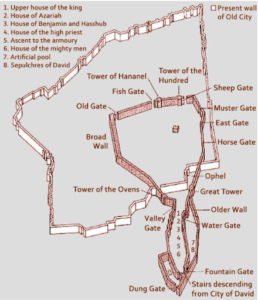
    As you read this chapter, you might have thought that a map would have been helpful. There are many names and instructions that are included. The Bible Knowledge Series by John Wavoord and Roy Zuck emphasize Nehemiah’s skill of delegation. This pushes us to ask the question: What is the relationship between the people and the section of wall they are delegated to build?

    People were assigned to build near their houses. Nehemiah knew that people would care more about the wall in front of their house rather than the wall on the other side of the city. Wavoord and Zuck offer other reasons for this purposeful delegation which include: “the people would waste less time traveling, the people would be less likely to flee in the event of an attack, and the whole family would have the opportunity to contribute.” All in all, people were designated to segments of the wall that they would care more about.

    What does this mean to us? As the church, we should be mindful of where we build. It would have been inefficient, poorly executed, and negligent if the people would have built a part of the wall they did not care about. As we build relationships, form connections, and outreach, we should be mindful of where we focus our energy. God purposely put you where you are. With that in mind, we should not neglect our surroundings. We should be intentional and purposeful in the places and with the people we see everyday.. Lastly, we should keep in mind that even though each group was working on their own section of the wall, they were working on one final project. 

    This seems to mirror our ministry as the church. We are uniquely connected to co-workers, friend groups, and family. We should remind ourselves that Jesus sends us into the world to build but we (the church) are all working on one project: Building the Kingdom of God.

    Questions

    1. Think about where God has you today. Why do you think He placed you there? 
    2. How do you see what you are doing in your community and how that relates to the Kingdom of God?
    3. What does this chapter teach you about Nehemiah? What does it teach you about God?

    Dig Deeper

    Are you trying to visualize exactly what the wall looked like? Check out this helpful map!                            


    Leave a Comment Below

    Did you learn something today? Share it with our Bible Reading Plan community by commenting below.

    Join the Team

    Interested in writing for the Bible Reading Plan? Email [email protected].

  • Rest Day 2

    Rest Day 2

    Rest Day

    Today is a Rest Day. There is no new Bible reading to do. Today, the goal is simple: rest in the presence of God. Maybe you need to use today to get caught up on the reading plan if you’re behind, maybe you want to journal what you’re learning so you don’t forget what God is teaching you, or maybe you want to spend time in concentrated prayer–do that. Above all, just spend time in God’s presence. Each Rest Day, we will also introduce a memory verse for the week. Meditate on this week’s verse and begin to memorize it.

    Memory Verse

    For Ezra had devoted himself to the study and observance of the Law of the Lord, and to teaching its decrees and laws in Israel.

    Ezra 7:10

    Memorization Tip

    Take the verse with you throughout your day. Write it on a post-it note and put it on your fridge, or your mirror, or your steering wheel–anywhere that you’ll see it and be reminded of what you’re memorizing throughout the day. Put it as the lock screen on your phone. And when you see it during the day, say it out loud, meditate on it, and work on memorizing it.

    Worship with Us

    Join us at 9a, 11a, or 7p in person or online at harriscreek.org/live. We’d love to worship with you! We also desire to connect everyone with a local church body where they can thrive in community and use their gifts to serve. If you’re following our Bible Reading Plan from outside of Waco and are eager to get connected with a great local church, email us at [email protected].

    Leave a Comment Below
    Did you learn something today? Share it with our Bible Reading Plan community by commenting below.